
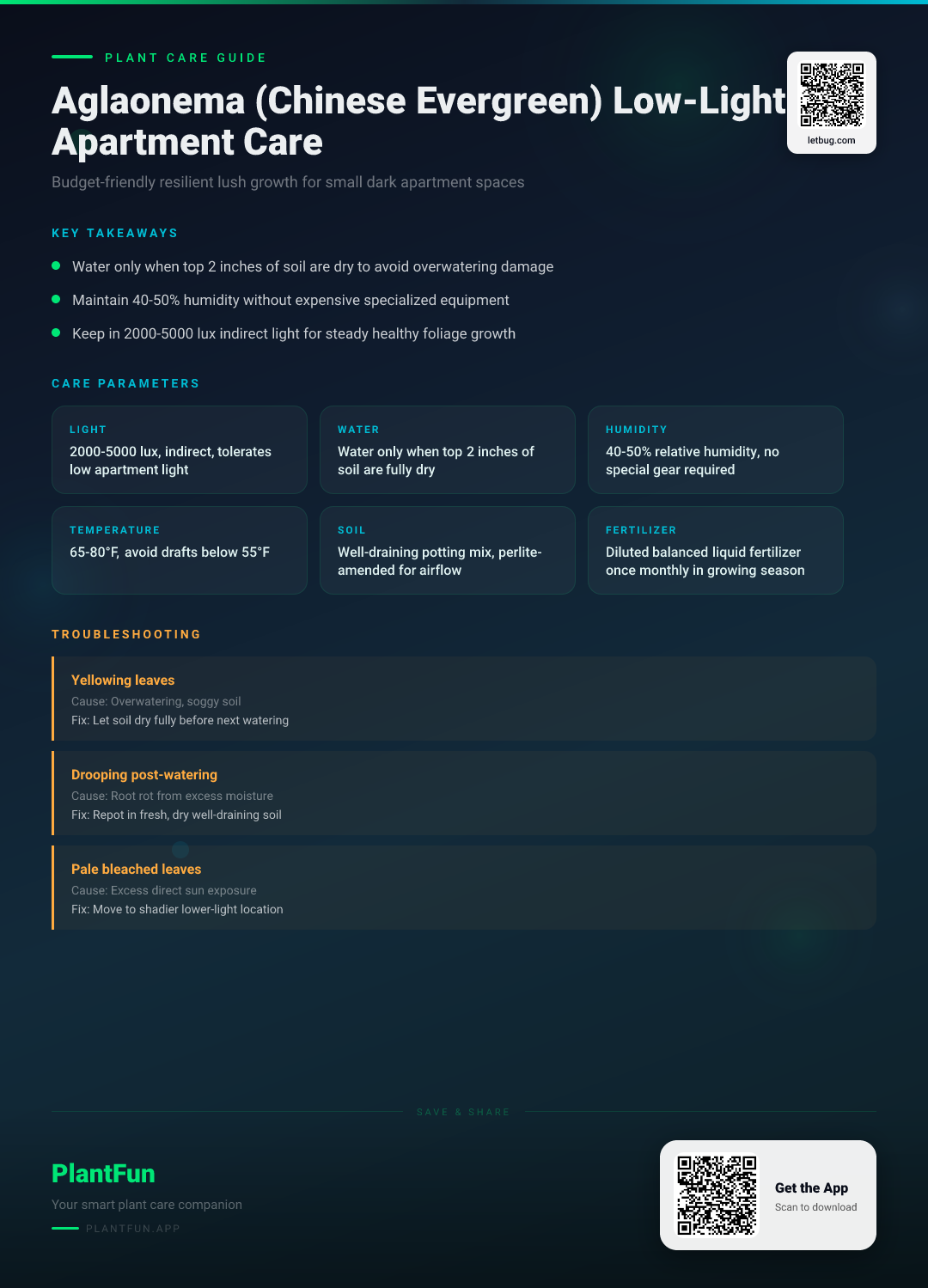
Key Takeaways
- Check soil moisture before watering — overwatering is the #1 killer of houseplants.
- Ensure your plant gets the right amount of light for its species.
- Be patient with recovery — most plants need 2–4 weeks to bounce back.
Quick Care Card: Measuring Light, Water, Soil, and Temp for your Aglaonema
| Feature | Requirement |
|---|---|
| Light | 2,000–5,000 Lux (Bright, indirect) |
| Water | Top 2 inches dry (approx. 7–14 days) |
| Humidity | 40–50% (Ambient) |
| Temperature | 65–80°F (18–27°C) |
| Soil | Well-draining, peat-based mix |
| Fertilizer | Balanced liquid feed, diluted by 50% |
| Toxicity | Toxic to cats and dogs (ASPCA, 2026) |
TL;DR: The Apartment Dweller’s Aglaonema Cheat Sheet
Aglaonema, or Chinese Evergreen, is the gold standard for low-light apartments because it retains its vibrant foliage in settings as low as 2,000 lux (NC State Extension, 2026). To keep yours thriving, wait until the top 2 inches of soil are dry before watering. Avoid over-fertilizing—a simple, balanced liquid feed once every two months is sufficient. Keep your plant away from direct sun and cold drafts, and remember to wash the leaves periodically to optimize gas exchange.
Why Aglaonema Is the Ultimate Apartment Plant (The Science of Shade Tolerance)
When I first started collecting plants, I made the mistake of placing a high-light cactus in a north-facing corner—a disaster that ended quickly. I soon turned to the Aglaonema. These plants are naturally evolved to thrive on forest floors under dense canopies, making them uniquely adapted to the dim conditions of apartment life (S & Fatmi, 2024). They are not just surviving; their structural resilience allows them to perform phytoremediation, potentially improving air quality in small living spaces (Ghate, 2016).
Setting Your Light: Achieving 2,000-5,000 Lux in Typical Apartment Corners
In my experience, many apartment owners overestimate how much light a corner gets. If you are 5-8 feet from a window, your plant is likely receiving only 1,000-2,000 lux. Aglaonema will survive here, but growth will be slow. To reach the optimal 2,000-5,000 lux threshold, place your plant within 3 feet of a window, ideally behind a sheer curtain to diffuse harsh rays that can scorch leaves (NC State Extension, 2026).
The Budget-Friendly Watering Schedule: Top 2 Inches Dry Rule Explained
I never use fancy soil moisture sensors. Instead, I use the “Finger Test”: push your index finger into the potting medium up to the second knuckle. If the soil feels damp, walk away. If it is dry, it’s time to hydrate. Overwatering is the most common killer of resilient indoor plants like these. Always ensure your pot has a drainage hole to prevent root rot.
Humidity Hacks: Maintaining 40-50% Without Buying a Greenhouse
Most apartments hover around 30-40% humidity, which is slightly dry for tropicals. You don’t need an expensive humidifier. I group my plants together to create a micro-climate where transpiration increases local humidity. If the tips of your leaves start browning, this is a sign you need to boost local moisture slightly.
Temperature Control: Why Your Apartment’s 65-80°F Range Is Perfect
Aglaonema thrive in the exact temperature range that humans find comfortable (65-80°F) (S & Fatmi, 2024). Keep your plant away from HVAC vents, as the artificial heat or cooling can dry out the foliage and cause stress. If you are comfortable in a t-shirt, your plant is likely happy too.
Step-by-Step: Diagnosing Leaf Yellowing (The #1 Apartment Aglaonema Problem)
Yellowing Lower Leaves
Symptom: Leaves at the base of the plant turn yellow and mushy.
Likely cause: Overwatering leading to root suffocation.
Fix:
- Check soil dryness immediately.
- Allow the soil to dry out completely for a full week.
- Repot into a container with better drainage if the current one lacks holes.
Yellowing with Brown Crisp Edges
Symptom: Foliage is yellowing at the margins while drying out.
Likely cause: Low humidity or salt buildup from tap water.
Fix:
- Use filtered or distilled water for one month.
- Mist the leaves once a week with a spray bottle.
Voice Search FAQ: ‘Why is my Aglaonema drooping even though I watered it?’
Drooping is often a sign of root damage from previous overwatering, not current underwatering. If the roots are rotted, they cannot transport water to the leaves, leading to the appearance of thirst (NC State Extension, 2026). Check the roots; they should be firm and white, not brown and mushy.
Voice Search FAQ: ‘Can I keep my Chinese Evergreen in a room with no windows?’
While it is one of the best plants for dark apartments, it still requires some level of ambient light to conduct photosynthesis. A room with zero natural light will eventually kill the plant. If you must keep it in a windowless room, you will need a low-cost LED grow bulb.
Voice Search FAQ: ‘How do I know if my Aglaonema is getting too much water?’
Look for edema—small, water-soaked bumps on the underside of the leaves. If the soil remains muddy for days after watering, you have likely exceeded the plant soil moisture levels the plant can handle.
Seasonal Adjustments: Managing Winter Stasis and Summer Growth Spurts
In winter, the plant enters a dormant phase. Growth slows, and water usage drops significantly. During these months, I reduce my watering frequency by half. In summer, as light levels increase, the plant will use more water and may benefit from a mild, balanced fertilizer (S & Fatmi, 2024).
Budget Care Plan: Avoiding Expensive Supplements and Retail Hype
You do not need $30 bottles of “leaf shine” or specialized fertilizers. A standard 10-10-10 fertilizer, used at half the recommended strength, is perfectly adequate. Dusting leaves with a damp microfiber cloth once a month is the best way to keep your plant healthy and shining naturally.
Common Mistakes That Kill Aglaonemas in Small Spaces
- Mistake: Placing the plant in direct sun.
- What happens: Leaf bleaching and irreversible sun scorch.
- Instead: Keep it in a bright, indirect light spot.
- Mistake: Using a pot without drainage.
- What happens: Water pools at the bottom, rotting the roots.
- Instead: Always use a pot with a drainage hole.
- Mistake: Ignoring pet safety.
- What happens: Ingestion causes oral irritation.
- Instead: Keep out of reach of curious pets (ASPCA, 2026).
References
- Ghate, S. (2016). Assessment of Phytoremediating Potential of Aglaonema commutatum Schott for Indoor Pollutants. International Journal of Plant and Environment. https://doi.org/10.18811/ijpen.v2i1-2.6622. Accessed 2026-03-18.
- S, A.; Fatmi, U. (2024). Performance of Different Aglaonema (Aglaonema commutatum) Varieties under Prayagraj Agro-climatic Conditions. International Journal of Plant & Soil Science. https://doi.org/10.9734/ijpss/2024/v36i84833. Accessed 2026-03-18.
- ASPCA. (2026). Toxic and Non-Toxic Plants List — ASPCA. https://www.aspca.org/pet-care/animal-poison-control/toxic-and-non-toxic-plants. Accessed 2026-03-18.
- NC State Extension. (2026). Aglaonema — NC State Extension Gardener Plant Toolbox. https://plants.ces.ncsu.edu/plants/aglaonema-care/. Accessed 2026-03-18.
Optional Helper: Plantfun.App
Plantfun.App identifies your plants by photo, diagnoses pests and diseases with clear fixes, and creates personalised watering and light schedules that adapt to your home conditions — a handy companion for putting this guide into daily practice.
Found an error or have suggestions? We'd love your feedback.
Need help identifying this problem?
Get instant identification, personalized care schedules, and effective pest treatment plans directly on your phone.
Sponsored • We may earn a commission from app downloads
Related Guides
Aglaonema in Low-Light Apartments: A Resilient Growth Guide for Beginners and Beyond
Transform your dim apartment into an indoor jungle. Master Aglaonema care with precise light, watering, and soil metrics designed to keep your foliage vibrant.
Care GuideChinese Evergreen Care in Typical Apartments: The Budget-Friendly Guide to Resilient Indoor Growth
Master Aglaonema care with 4 simple environmental checks. Save money and boost growth in your apartment with this expert-led, budget-friendly maintenance plan.
Care GuideThe Complete Aglaonema Care Checklist for Resilient Growth in Small Apartments
Grow lush, low-fuss Aglaonema even in cramped city apartments with this science-backed checklist, including exact light, water, and soil parameters for resilient, pest-free growth.
Pest ControlAnts on Plants: What They Mean and What to Do
Ants usually aren't eating your plant. They are farming other pests.