
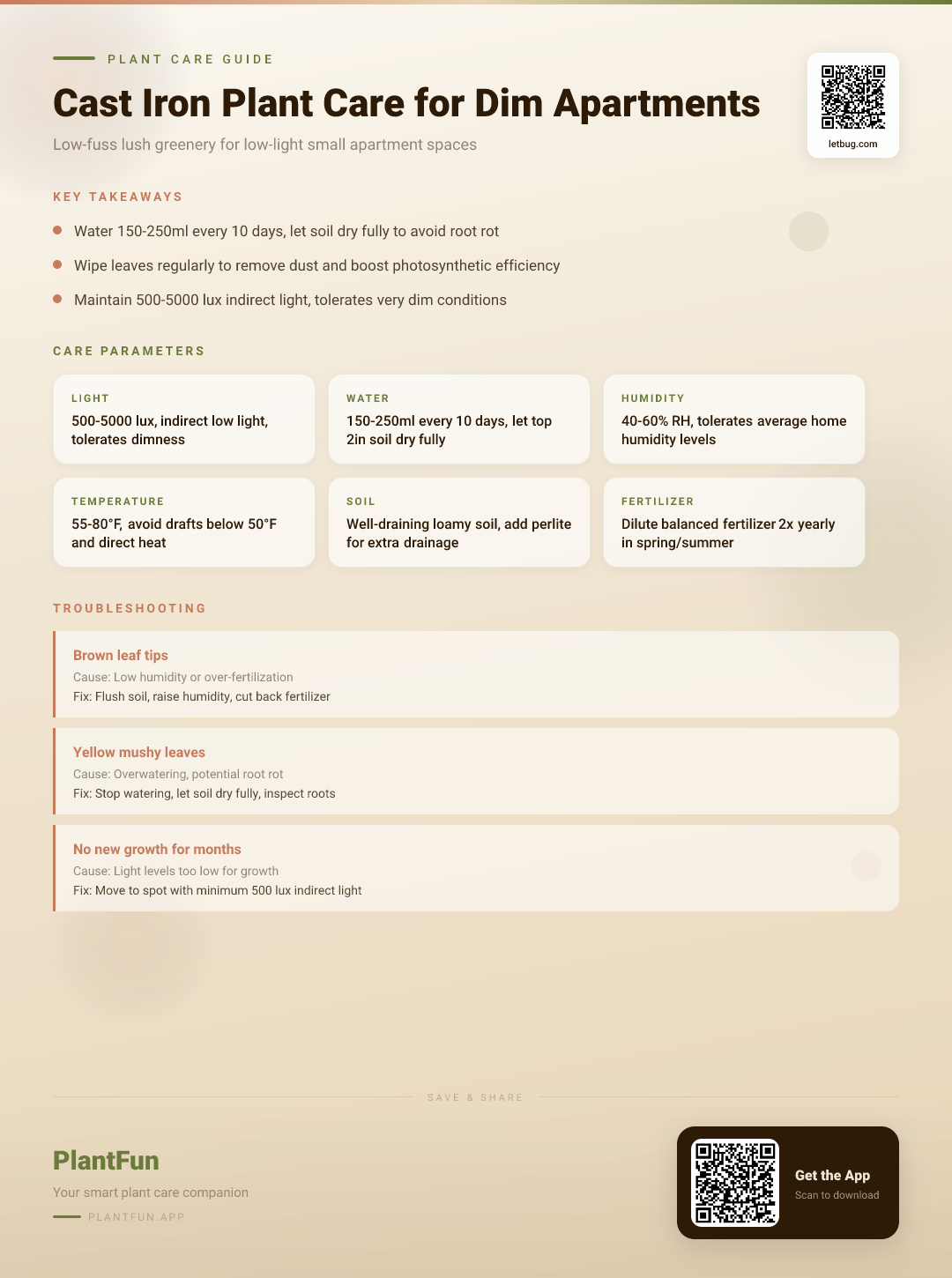
Key Takeaways
- Check soil moisture before watering — overwatering is the #1 killer of houseplants.
- Ensure your plant gets the right amount of light for its species.
- Be patient with recovery — most plants need 2–4 weeks to bounce back.
Quick Care Card: Essential Data
| Feature | Requirement |
|---|---|
| Light | 500–5,000 lux (Indirect low to medium) |
| Temperature | 55–80°F (13–27°C) |
| Watering | 150–250ml per 10 days (Season dependent) |
| Humidity | 40–60% |
| Soil | Well-draining peat-based mix |
| Fertilizer | Balanced liquid (10-10-10) monthly in summer |
| Toxicity | Non-toxic to cats and dogs (ASPCA, 2026) |
TL;DR: The Reality of Aspidistra Growth in Small Spaces
The Aspidistra elatior is famously known as the “Cast Iron Plant” due to its historical ability to withstand the smog and low light of Victorian parlors. In your apartment, it isn’t “unkillable,” but it is incredibly resilient. It thrives in 500–5,000 lux of light and requires moderate water (150-250ml) only when the top two inches of soil feel dry. The biggest threat to its health is not darkness, but root rot caused by over-attentive watering (NC State Extension, 2026).
Why Your Cast Iron Plant Actually Needs Light to Survive
When I first brought my Aspidistra home, I tucked it in a windowless corner, thinking the “low-light” label meant it didn’t need a photon of sunlight. I quickly realized my mistake: while it survives in dark spots, it barely grows. Photosynthesis requires light energy to convert water and carbon dioxide into sugars (Gilman, 2014). Without enough light, the plant will slowly consume its own energy stores, eventually leading to leaf drop. You need to provide at least some ambient light for long-term health.
The 500-5,000 Lux Rule: Measuring Light in Your Apartment
Light intensity is often overestimated. 500 lux is roughly equivalent to a dimly lit hallway; 5,000 lux is a bright spot a few feet away from a north-facing window.
- Test it: Use a free light meter app or a dedicated sensor.
- The sweet spot: Place your plant where it can “see” the sky but not direct sun, which can scorch its leathery leaves.
- Adaptation: If moving it from a dim nursery to a brighter home, do so gradually over two weeks to prevent leaf burn.
Watering Mastery: Why Less is More for Low-Light Specimens
In low-light conditions, transpiration slows down significantly. If you water on a strict schedule regardless of light levels, the roots will sit in stagnant water, leading to decay. I always perform the “finger test”: stick your index finger two inches into the soil. If it feels cool or damp, skip the water. When you do water, use roughly 150-250ml, ensuring the excess drains away completely. Never let the pot sit in a saucer of water (NC State Extension, 2026).
Step-by-Step Guide: Potting, Soil Drainage, and Root Protection
- Select the Pot: Use a container with ample drainage holes. Ceramic or terracotta is ideal for apartment dwellers to help excess moisture evaporate.
- Choose the Right Soil: Use a high-quality, peat-based potting mix mixed with 20% perlite for drainage.
- Repotting: Aspidistra have a slow growth rate and prefer to be slightly pot-bound. Only repot every 2-3 years, moving up only one pot size (e.g., from a 6-inch to an 8-inch pot).
- Drainage: Place a layer of landscape fabric at the base of the pot to keep the soil from clogging the drainage holes.
Seasonal Shifts: How to Adjust Care for Radiator-Heated Apartments
Winter in an apartment often means low humidity and dry air from radiators. While Aspidistra is more tolerant than a Fiddle Leaf Fig, it still struggles when humidity drops below 30%. I keep mine away from direct heating vents. If the room feels dry, grouping it with other plants creates a microclimate that boosts ambient moisture naturally.
Voice FAQ
Why is my Cast Iron Plant leaf tip turning brown?
This is usually a signal of inconsistent watering or “tip burn” caused by mineral buildup in the soil. I recommend flushing the soil with filtered water once a month to wash away salts.
Can I keep my Cast Iron Plant in a windowless bathroom?
Technically, no plant survives without any light. If your bathroom has no windows, you must use a dedicated grow light to provide the minimum 500 lux needed for metabolic processes.
Does it need high humidity?
No. Aspidistra is remarkably adaptable and does perfectly well in standard home humidity (40-60%) (NC State Extension, 2026).
Common Mistakes: Avoiding the ‘Unkillable’ Neglect Trap
- Mistake: Using a decorative pot without drainage. What happens: Water accumulates at the bottom, rotting the root crown. Instead: Use a plastic nursery liner inside the decorative pot.
- Mistake: Cleaning leaves with harsh chemicals. What happens: You damage the plant’s stomata, impeding gas exchange. Instead: Use a damp microfiber cloth.
Professional Pro-Tip: Cleaning Leaves for Photosynthetic Efficiency
Dust is the enemy of low-light plants. When the leaves are covered in dust, the plant cannot absorb the limited light available to it (Gilman, 2014). Every month, I gently wipe both the tops and bottoms of the leaves with a damp cloth. This simple act keeps the plant “breathing” and ensures every bit of available light is converted into growth.
References
- Gilman, E. (2014). Aspidistra elatior Cast Iron Plant. EDIS. https://doi.org/10.32473/edis-fp053-1999. Accessed 2026-03-18.
- Banfield, R.; Gaskell, D. (1966). Cast Iron Failures in Sulphuric Acid Plant. Anti-Corrosion Manual. https://doi.org/10.1108/eb006715. Accessed 2026-03-18.
- ASPCA. (2026). Toxic and Non-Toxic Plants List — ASPCA. https://www.aspca.org/pet-care/animal-poison-control/toxic-and-non-toxic-plants. Accessed 2026-03-18.
- NC State Extension. (2026). Cast Iron Plant — NC State Extension Gardener Plant Toolbox. https://plants.ces.ncsu.edu/plants/plant-care/. Accessed 2026-03-18.
Optional Helper: Plantfun.App
Plantfun.App identifies your plants by photo, diagnoses pests and diseases with clear fixes, and creates personalised watering and light schedules that adapt to your home conditions — a handy companion for putting this guide into daily practice.
Found an error or have suggestions? We'd love your feedback.
Need help identifying this problem?
Get instant identification, personalized care schedules, and effective pest treatment plans directly on your phone.
Sponsored • We may earn a commission from app downloads
Related Guides
Cast Iron Plant in Dim Apartments: A Foolproof Guide to Resilient Indoor Growth
Transform your dark apartment corner into a lush oasis with the Cast Iron Plant. Discover precise watering cycles and light levels that guarantee resilient growth.
Care GuideAspidistra Elatior in a Low-Light Apartment: The Complete Care Guide for Resilient Growth
Transform your dim apartment into a green oasis with the Cast Iron Plant. Get precise light, watering, and soil care steps that guarantee 100% resilient growth.
Care GuideAspidistra Elatior (Cast Iron Plant) Care Checklist for Apartments: Grow Lush, Resilient Leaves Easily
Stop accidentally harming your nearly indestructible Cast Iron Plant. Get exact light, water, humidity thresholds, 7 common apartment care mistakes, and a free printable checklist for lush, year-round growth.
Pest ControlAnts on Plants: What They Mean and What to Do
Ants usually aren't eating your plant. They are farming other pests.