
Key Takeaways
- Check soil moisture before watering — overwatering is the #1 killer of houseplants.
- Ensure your plant gets the right amount of light for its species.
- Be patient with recovery — most plants need 2–4 weeks to bounce back.
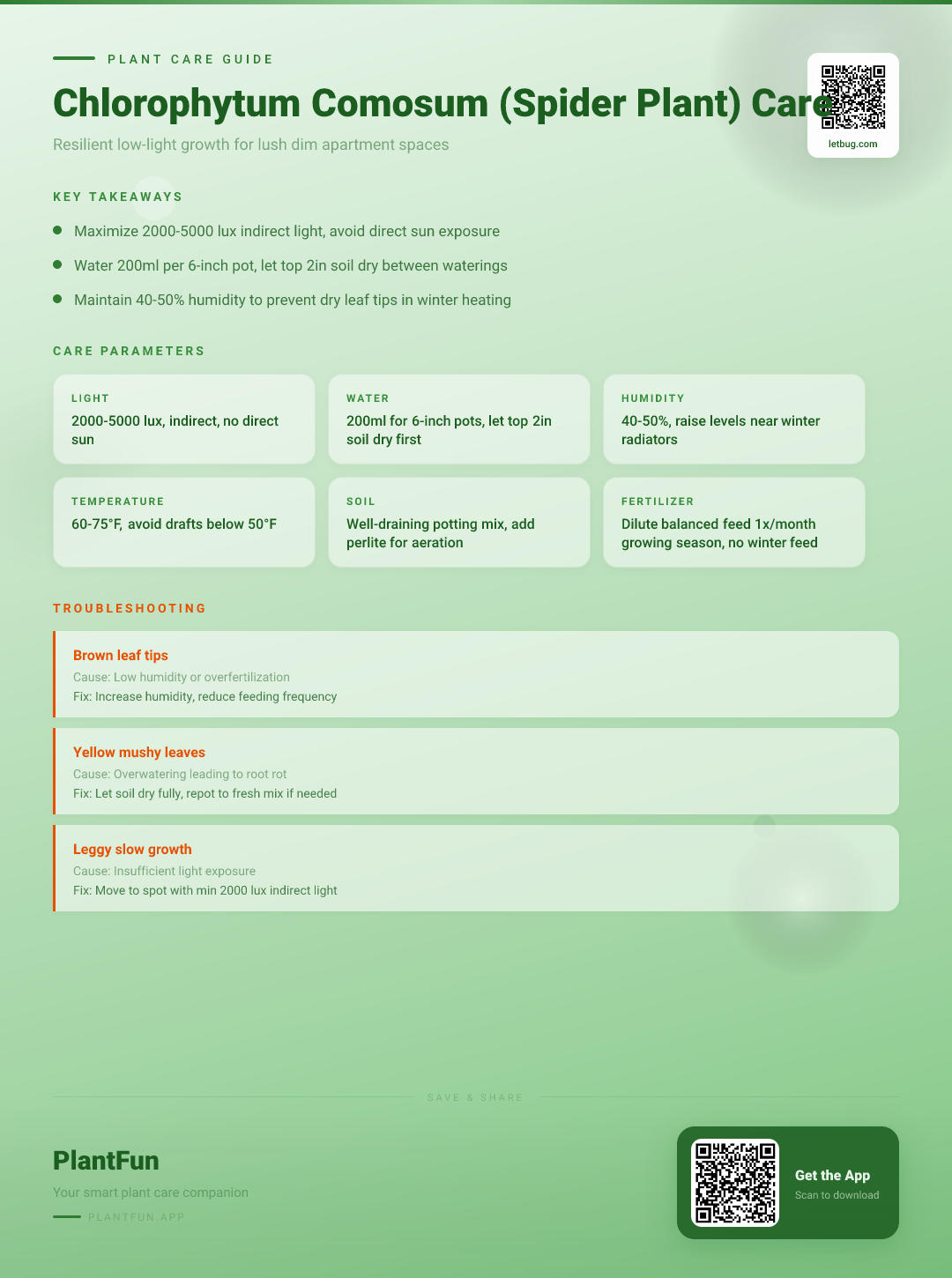
Quick Care Card: Essential Thresholds for Apartment Success
| Feature | Threshold for Success |
|---|---|
| Light | 2,000–5,000 Lux (Bright, indirect) |
| Water | Allow top 2 inches of soil to dry |
| Humidity | 40–50% (Consistent) |
| Temperature | 60°F–75°F (15°C–24°C) |
| Soil | Well-draining, peat-based mix |
| Fertilizer | Balanced liquid feed (monthly in spring/summer) |
| Toxicity | Non-toxic to pets (ASPCA, 2026) |
TL;DR: The Reality of Spider Plants in Dim Environments
Spider Plants (Chlorophytum comosum) are remarkably adaptable, but they aren’t magic. In low-light apartments, growth slows significantly. To keep them thriving, prioritize light maximization near windows, reduce watering frequency to prevent root rot, and maintain stable temperatures. They are not indestructible, but with these adjustments, they remain one of the most rewarding houseplants for beginners.
Why Your Apartment Isn’t a Greenhouse (And That’s Okay)
When I first brought my Chlorophytum comosum into my studio apartment, I made the mistake of placing it in a dark corner, assuming its “low-light” reputation meant it thrived in near-total shade. It stalled, stopped producing pups, and developed lackluster, pale foliage. I had to learn that “low light” is relative. While they can tolerate lower intensities, their ability to reduce indoor air toxins like formaldehyde (Zhao et al., 2014) and assist in carbon monoxide management (Wicaksono et al., 2022) is directly tied to their metabolic health, which depends on adequate light.
Step 1: Managing Light – How to Maximize 2,000-5,000 Lux Without Direct Sun
To keep your plant healthy without a south-facing window, you need to be strategic. Spider Plants require consistent, bright, indirect light to produce those signature “spiderettes.” If your apartment sits in the 2,000 lux range, the plant will survive but grow slowly. To maximize your available light:
- Distance counts: Move your plant within 2-3 feet of your brightest window.
- Clean the leaves: Dust acts as a filter. Gently wipe leaves with a damp cloth every two weeks to ensure maximum photosynthetic efficiency.
- Reflective placement: If you lack space near the window, place the plant near a light-colored wall or mirror to bounce available photons back onto the foliage.
Step 2: Hydration Science – Watering Cycles Based on Pot Size
Overwatering is the primary killer of indoor Spider Plants. My rule of thumb is to check the soil moisture manually before reaching for the watering can. Stick your finger 2 inches into the soil; if it feels damp, wait.
- 6-inch pot: Aim for roughly 150-200ml of water per session, applied only when the top 2 inches of soil are dry (NC State Extension, 2026).
- Frequency: During winter, reduce this frequency by half, as the plant enters a period of dormancy where transpiration rates decrease.
Step 3: Humidity & Airflow – Maintaining 40-50% Humidity in Dry Winter Radiator Heat
Apartment heating systems, especially radiators, create arid “deserts” in your living space. To combat this, keep your plant away from direct heat vents. If your home humidity drops below 30%, consider a pebble tray filled with water to increase localized moisture without creating soggy soil conditions.
Step 4: Fertilization Strategy – Why ‘Less is More’ for Resilient Growth
Because growth is slower in apartments, you don’t need heavy fertilization. Use a balanced, water-soluble fertilizer diluted to half-strength once every four to six weeks during the growing season (spring and summer). Avoid feeding entirely during the winter when the plant is resting.
Seasonal Care Calendar: From High-Growth Summer to Dormant Winter
- Spring: Increase light exposure; begin monthly fertilization.
- Summer: Peak growth period; maintain consistent moisture; watch for new pups.
- Autumn: Gradually reduce water as light levels decrease.
- Winter: Keep away from drafts; avoid all fertilizer; allow soil to dry out more between waterings.
Myth-Busting: Do Spider Plants Really Thrive on Neglect?
This is a dangerous misconception. While Chlorophytum comosum can tolerate short periods of drying out due to its tuberous, water-storing roots (NC State Extension, 2026), constant neglect leads to root death and “burned” foliage. They thrive on consistent care, not non-existent care.
Voice Search FAQ
Why are my Spider Plant tips turning brown in my apartment?
Brown tips are often a result of low humidity or “salt burn” from tap water minerals. Try switching to filtered water or increasing the humidity around the plant using a pebble tray.
Can I grow a healthy Spider Plant with only artificial office lighting?
Yes, provided the plant is within 12-18 inches of a full-spectrum LED light source for at least 8-10 hours a day.
How do I know if I am overwatering my plant?
Look for yellowing leaves at the base and a “mushy” stem texture. If you suspect overwatering, check the roots; healthy roots are firm and white, while rot-affected roots are brown, slimy, and emit an odor.
Common Mistakes: Avoiding Root Rot in Plastic vs. Terra Cotta Pots
- Mistake: Planting in a pot without drainage holes.
- What happens: Water pools at the bottom, leading to anaerobic conditions and root rot.
- Instead: Always use a nursery pot with drainage holes inside a decorative planter.
- Mistake: Choosing the wrong material.
- What happens: Plastic retains moisture longer; terra cotta wicks it away.
- Instead: If you are prone to overwatering, opt for porous terra cotta to assist with soil oxygenation.
References
- Zhao, X., Zhang, N., Shu, H. (2014). Study on the Purification Effect of Chlorophytum Comosum on Indoor Formaldehyde. Applied Mechanics and Materials. https://doi.org/10.4028/www.scientific.net/amm.675-677.229. Accessed 2026-03-19.
- Wicaksono, R., Putri, M., ., A. (2022). Investigation of indoor spider plant (Chlorophytum comosum) affecting the carbon monoxide and carboxyhemoglobin reduction. Ecology, Environment and Conservation. https://doi.org/10.53550/eec.2022.v28i01s.008. Accessed 2026-03-19.
- ASPCA. (2026). Toxic and Non-Toxic Plants List — ASPCA. https://www.aspca.org/pet-care/animal-poison-control/toxic-and-non-toxic-plants. Accessed 2026-03-19.
- NC State Extension. (2026). Chlorophytum Comosum — NC State Extension Gardener Plant Toolbox. https://plants.ces.ncsu.edu/plants/plant-care/. Accessed 2026-03-19.
Optional Helper: Plantfun.App
Plantfun.App identifies your plants by photo, diagnoses pests and diseases with clear fixes, and creates personalised watering and light schedules that adapt to your home conditions — a handy companion for putting this guide into daily practice.
Found an error or have suggestions? We'd love your feedback.
Need help identifying this problem?
Get instant identification, personalized care schedules, and effective pest treatment plans directly on your phone.
Sponsored • We may earn a commission from app downloads
Related Guides
Spider Plant Care for Small Apartments: Mastering Resilient Growth in Limited Vertical Space
Transform your small apartment into a lush oasis. Master Spider Plant care with precise light, water, and humidity thresholds designed for compact living spaces.
Care GuideSpider Plant Care for Small Apartments: A 4-Season Guide to Lush, Resilient Growth
Transform your small apartment with a vibrant Chlorophytum comosum. Follow our 4-season routine with precise light, water, and humidity data for year-round growth.
Care GuideSpider Plant Care in Apartment Living: The Ultimate Resilient Growth Guide for Beginners
Revive your Spider Plant with this science-backed apartment guide. Learn exact watering frequencies, light thresholds, and growth hacks for 100% leaf health.
Pest ControlAnts on Plants: What They Mean and What to Do
Ants usually aren't eating your plant. They are farming other pests.