
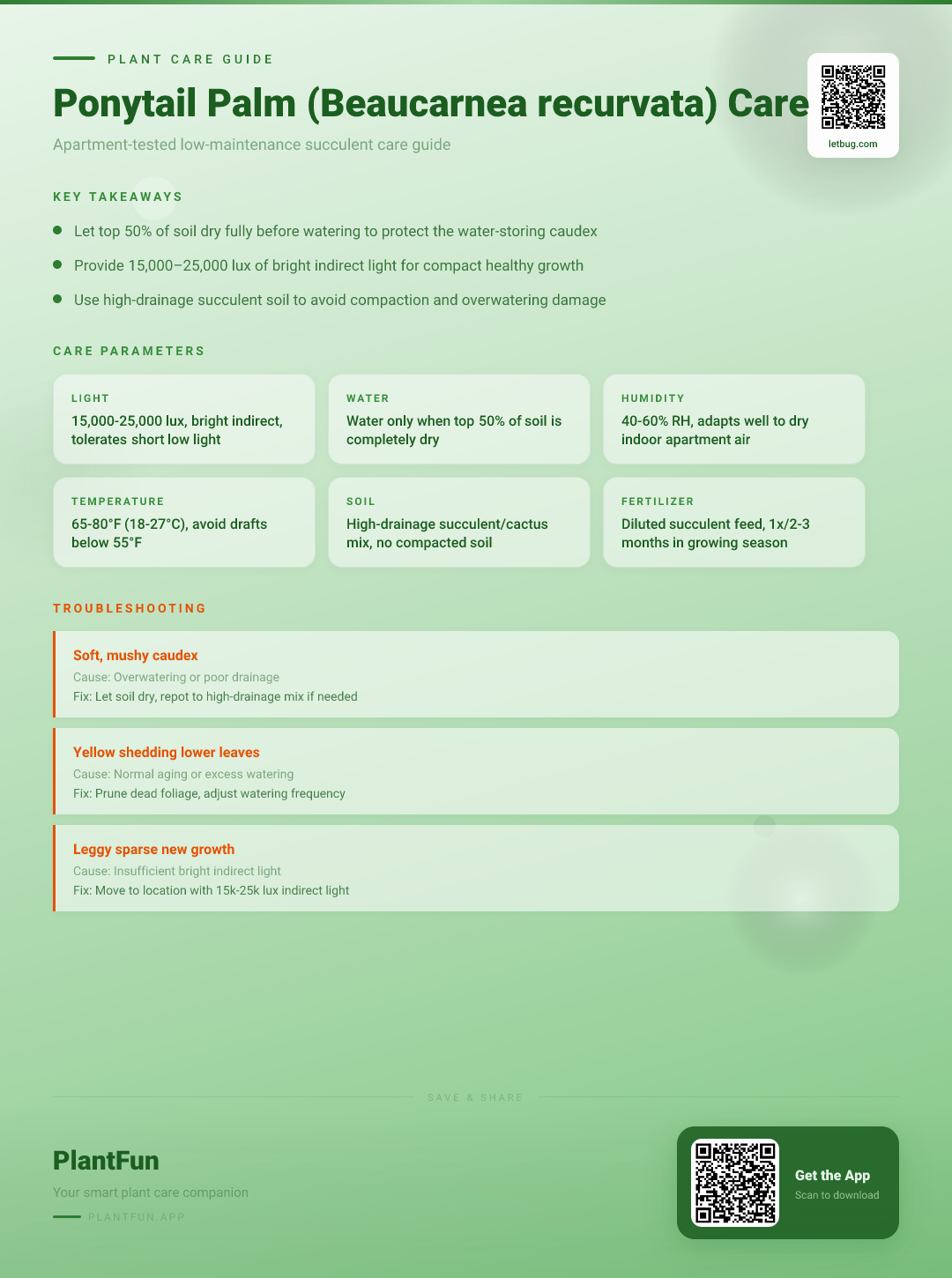
Key Takeaways
- Check soil moisture before watering — overwatering is the #1 killer of houseplants.
- Ensure your plant gets the right amount of light for its species.
- Be patient with recovery — most plants need 2–4 weeks to bounce back.
Quick Care Card: Essential Parameters for Apartment Success
| Parameter | Requirement |
|---|---|
| Light | Bright, indirect (15,000–25,000 lux) |
| Water | Only when soil is 50% dry |
| Humidity | Low to moderate (30-50%) |
| Temperature | 65–80°F (18–27°C) |
| Soil | Fast-draining succulent/cactus mix |
| Fertilizer | Balanced liquid feed, monthly in summer |
| Toxicity | Non-toxic (ASPCA, 2026) |
TL;DR: Why Your Ponytail Palm Is Actually a Succulent
Despite its name, the Beaucarnea recurvata is not a palm; it is a drought-tolerant succulent native to arid regions of Mexico. My experience has taught me that the biggest mistake beginners make is treating it like a tropical plant. If you want a thriving ponytail palm indoor care routine, focus on mimicking its desert origins: lots of light, minimal water, and aggressive drainage.
Understanding the Caudex: Nature’s Internal Water Reservoir
The most striking feature of the ponytail palm is its swollen base, or caudex. This organ serves as a water storage vessel, allowing the plant to survive prolonged dry spells (Gilman & Watson, 2003). When I first started keeping these, I didn’t realize that a firm caudex is a sign of a healthy hydration level, while a squishy, soft one is a major red flag for root rot caused by overwatering.
Ideal Apartment Lighting: Providing 15,000–25,000 Lux for Compact Growth
Apartment dwellers often struggle with light, but Beaucarnea recurvata requires significant intensity to maintain its characteristic compact shape. In my experience, north-facing windows rarely provide the 15,000–25,000 lux necessary for optimal health. If your plant is leaning aggressively, it is reaching for light. Consider supplementing with full-spectrum LED grow lights for 10-12 hours daily during winter months to prevent etiolation.
The 50% Rule: Watering Thresholds and Soil Drying Cycles
In an apartment setting with limited airflow, soil stays wet longer. My “50% rule” is simple: wait until the soil is dry at least halfway down the pot before you reach for the watering can. Use a wooden dowel or your finger; if you feel moisture at the 2-inch mark, keep the water away. Overwatering is the single most common cause of decline, as noted in horticultural studies on growing media (Annals of Agricultural Science, 2014).
Temperature & Humidity Control: Keeping 65–80°F (18–27°C) in Drafty Flats
Ponytail palms are resilient, but they despise cold drafts. Keep your plant away from AC vents or drafty window panes. They perform best at a steady 65–80°F (18–27°C). Because they store water efficiently, they actually prefer the lower humidity levels typically found in modern, climate-controlled apartments (Gilman & Watson, 2003).
Step-by-Step Repotting: Choosing High-Drainage Substrate for Apartment Containers
- Select a Pot: Choose a pot with large drainage holes. Terracotta is my go-to for indoor succulents because it wicks moisture away from the roots.
- The Mix: Combine 50% high-quality potting soil with 50% perlite or pumice to ensure rapid water flow (Annals of Agricultural Science, 2014).
- Repotting: Gently remove the plant, prune any mushy roots, and repot. Never bury the caudex deeper than it was previously.
- Settling: Wait one full week before watering to allow any root micro-injuries to heal.
Seasonal Care Calendar: Adjusting for Winter Light Drops and Summer Growth
- Spring/Summer: This is the active growing period. If you have bright light, water every 2-3 weeks, ensuring complete saturation and then total drainage.
- Fall/Winter: Growth slows significantly. Reduce watering frequency to once every 4-6 weeks, or until the caudex shows very minor signs of puckering.
Common Apartment Mistakes: Avoiding Soil Compaction and Improper Drainage
- Mistake: Using a pot without a drainage hole. What happens: Water pools at the bottom, rotting the roots. Instead: Use a nursery liner inside a decorative pot.
- Mistake: Using dense, garden-variety soil. What happens: Soil compacts, preventing oxygen from reaching roots. Instead: Use a dedicated cactus and succulent mix.
FAQ: Why is my Ponytail Palm shedding lower leaves?
Lower leaf yellowing is often a normal part of the aging process. However, if leaf tips are turning brown, it is usually a sign of low humidity or mineral buildup from tap water. Try using filtered water to see if the issue resolves.
FAQ: How often should I water my Ponytail Palm in a dry apartment?
Because of the lower humidity, the soil may dry faster than in a greenhouse. Always test the soil depth rather than following a calendar. If it feels dry to the touch 2-3 inches deep, it is safe to water.
FAQ: Can I place my Ponytail Palm in a north-facing studio?
Generally, no. A north-facing window typically provides less than 5,000 lux, which is insufficient for the long-term health of Beaucarnea recurvata. You will need a high-quality grow light setup to keep it alive.
Troubleshooting Guide: Identifying Softness in the Caudex
Stem Rot
Symptom: The trunk feels spongy or mushy to the touch.
Likely cause: Chronic overwatering or poor soil drainage.
Fix:
- Remove the plant from the pot immediately.
- Trim away all dark, slimy roots with sterile shears.
- Repot in fresh, dry, fast-draining substrate and hold all water for two weeks.
Dehydration
Symptom: The caudex looks shriveled or deeply wrinkled.
Likely cause: Underwatering for an extended period.
Fix:
- Give the plant a thorough soak until water drains from the bottom.
- Monitor the caudex for firmness over the next 48 hours.
References: Botanical Standards for Beaucarnea recurvata
- Gilman, E.; Watson, D. (2003). Beaucarnea recurvata: Ponytail palm. https://doi.org/10.32473/edis-st093-1993. Accessed 2026-03-17.
- Annals of Agricultural Science, Moshtohor. (2014). Effect of different growing media and chemical fertilization on growth and chemical composition of ponytail palm (Beaucarnea recurvata) plant. https://doi.org/10.21608/assjm.2014.111131. Accessed 2026-03-17.
- ASPCA. (2026). Toxic and Non-Toxic Plants List — ASPCA. https://www.aspca.org/pet-care/animal-poison-control/toxic-and-non-toxic-plants. Accessed 2026-03-17.
Optional Helper: Plantfun.App
Plantfun.App identifies your plants by photo, diagnoses pests and diseases with clear fixes, and creates personalised watering and light schedules that adapt to your home conditions — a handy companion for putting this guide into daily practice.
Found an error or have suggestions? We'd love your feedback.
Need help identifying this problem?
Get instant identification, personalized care schedules, and effective pest treatment plans directly on your phone.
Sponsored • We may earn a commission from app downloads
Related Guides
The Complete Ponytail Palm Care Checklist for Resilient Growth in Small Urban Apartments
Grow a lush, full Ponytail Palm in your small urban apartment without expensive gear. Get exact light levels, water amounts, and a free printable care checklist for resilient, low-fuss growth.
Care GuidePonytail Palm Care Checklist for Resilient Growth in Typical Urban Apartments: Fixes for Common Beginner Mistakes
Stop guessing at Ponytail Palm care. Get our apartment-specific checklist with exact light, water, and soil specs to prevent brown tips and encourage steady, resilient growth all year.
Care GuidePonytail Palm in Small Apartments: The Essential Care Guide for Resilient, Slow-Growth Success
Master Ponytail Palm care in small spaces with our precise, expert-backed guide. Get exact light, water, and soil requirements to keep your palm thriving today.
Pest ControlAnts on Plants: What They Mean and What to Do
Ants usually aren't eating your plant. They are farming other pests.