
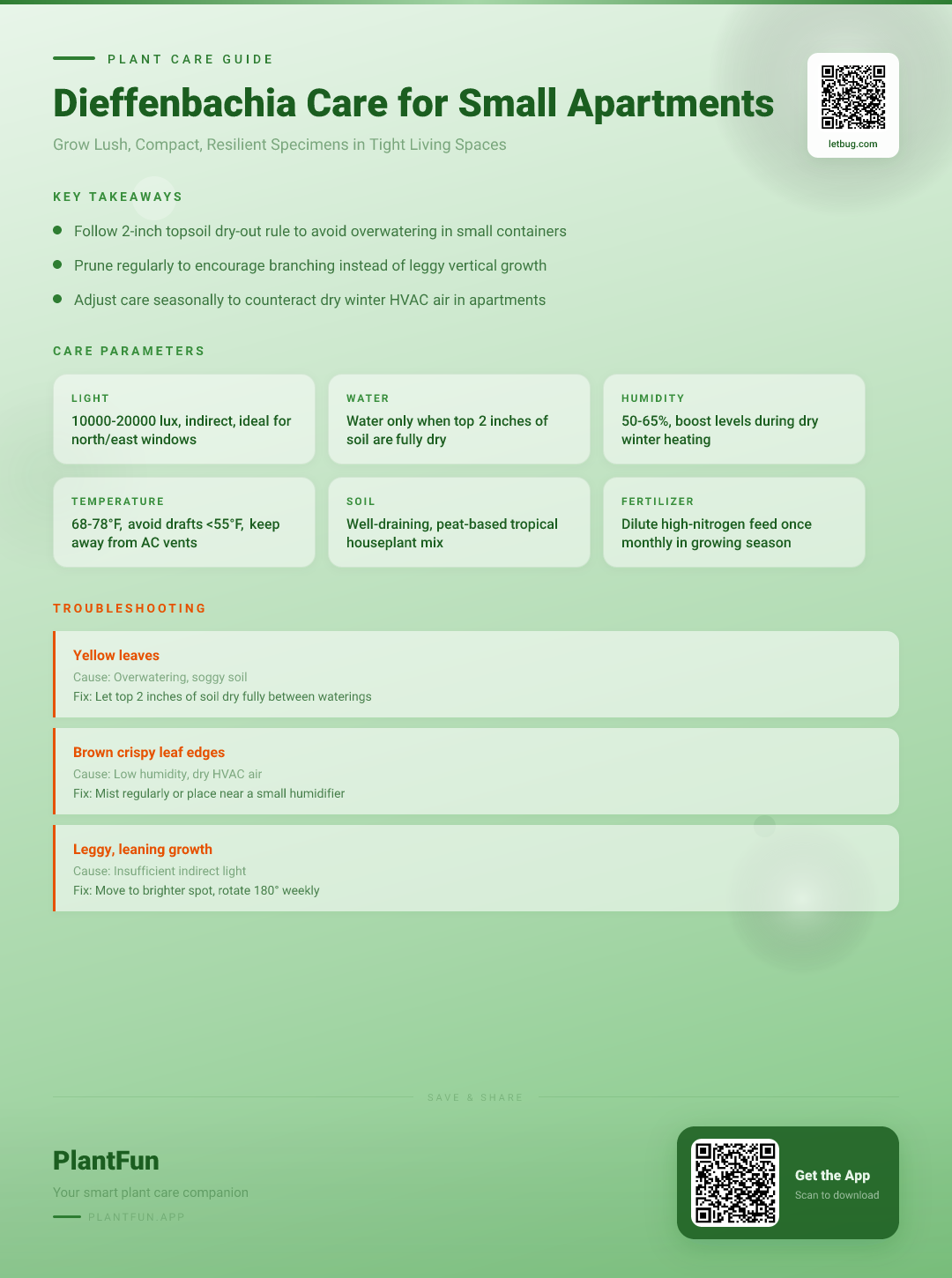
Key Takeaways
- Check soil moisture before watering — overwatering is the #1 killer of houseplants.
- Ensure your plant gets the right amount of light for its species.
- Be patient with recovery — most plants need 2–4 weeks to bounce back.
TL;DR: Quick Success Summary
Dieffenbachia are tropical giants, but they thrive in apartments if you mimic their native forest understory. Maintain bright, indirect light (10,000–20,000 lux), water when the top 2 inches of soil are dry, and provide 50–65% humidity. Avoid low-light corners, which cause “legginess,” and remember that this plant is toxic if ingested (ASPCA, 2026).
Quick Care Card: Essential Data
| Feature | Requirement |
|---|---|
| Light | 10,000–20,000 lux (bright, indirect) |
| Watering | 2-inch topsoil dry-out rule |
| Humidity | 50–65% constant |
| Temperature | 68–78°F (20–25°C) |
| Soil Mix | Well-draining, peat-based mix |
| Fertilizer | Dilute, balanced liquid (10-10-10) |
| Toxicity | Toxic to cats, dogs, and humans (ASPCA, 2026) |
My Experience: The “Leggy” Lesson
When I first brought home my Dieffenbachia seguine, I tucked it into a cozy, low-light reading corner of my studio. Within two months, it had doubled in height but lost half its leaves, leaving behind a pathetic, bamboo-like stalk. I learned the hard way that these plants aren’t “low light” tolerant—they are simply “shade-capable.” Once I moved it to a spot just three feet from my east-facing window, the internodes shortened, and it finally grew the lush, bushy habit I see in botanical magazines.
Why Your Apartment is Actually a Secret Greenhouse: Understanding the Dieffenbachia’s Growth Pattern
Dieffenbachia plants are adapted to the forest floor, meaning they are built for stable, filtered light. In an apartment, your windows act as the forest canopy. Because indoor environments often lack the wind and rapid temperature fluctuations of the outdoors, Dieffenbachia can grow surprisingly fast if you optimize their micro-climate (NC State Extension, 2026).
Light Science: How to maximize photosynthesis in north or east-facing studio windows
To keep your plant compact, you must meet its 10,000–20,000 lux threshold. In an apartment, use a light meter app on your phone to check the light level at the plant’s foliage, not the floor. If you are stuck with north-facing windows, move the plant directly onto the windowsill. If the leaves reach toward the glass, it is starving for energy.
Precision Watering: Why small space containers trap moisture differently than nursery pots
Small apartments often have less airflow than greenhouses. This means that a pot sitting on a shelf can stay soggy at the bottom long after the surface feels dry. Always use a pot with a drainage hole. If you notice your plant looks “off,” check the root health; poor drainage can lead to root rot, which creates the same symptoms as drought (Ajay & Fatmi, 2024).
The 2-Inch Rule: Identifying the exact point of dehydration for your Dieffenbachia
Don’t water on a schedule. Instead, stick your finger 2 inches into the soil. If it feels cool and damp, step away. If it feels dry and crumbly, it is time to hydrate. This technique ensures the roots have access to oxygen, which is vital for preventing systemic infections (Chase, 1982).
Fertilizing for Resilience: A high-nitrogen, dilute approach for restricted root zones
Because your plant is in a container, nutrients leach out quickly. Use a balanced, water-soluble fertilizer diluted to half-strength once a month during the growing season (spring and summer). Avoid heavy feeding in winter, as the plant’s metabolic rate drops significantly.
Seasonal Shifts: Adjusting your care routine for apartment HVAC dry air in winter
Winter in an apartment is a recipe for crispy leaf tips. HVAC systems strip the air of moisture. Supplement your plant with a nearby pebble tray or a humidifier to maintain that 50–65% humidity range. If the room is drafty, move the plant away from the window at night to protect it from cold shock (NC State Extension, 2026).
Space-Saving Pruning: How to force branching instead of vertical growth
If your Dieffenbachia is hitting the ceiling, don’t be afraid to chop the top off. Using a sanitized blade, cut the main stem just above a leaf node. This triggers the plant to send out side shoots, turning your tall, single-stalk plant into a multi-stemmed, bushy specimen.
Troubleshooting Guide: Identifying yellow leaves vs. brown crispy edges
Yellowing Lower Leaves
Symptom: The oldest leaves near the base turn yellow and drop.
Likely cause: Natural aging or overwatering.
Fix:
- Check the soil moisture; if saturated, let it dry completely.
- Ensure the plant is not sitting in standing water in a decorative pot cover.
Brown, Crunchy Edges
Symptom: Leaf tips and edges turn brittle and brown.
Likely cause: Low humidity or salt buildup from tap water.
Fix:
- Increase ambient humidity with a small humidifier.
- Flush the soil with distilled water once a month to wash out fertilizer salts.
Stalled Growth
Symptom: No new leaves for several months.
Likely cause: Insufficient light or root-bound conditions.
Fix:
- Move the plant to a brighter location.
- Check if roots are circling the bottom of the pot; if so, repot into a container only 1–2 inches wider.
FAQ: Frequently Asked Questions
- Why is my Dieffenbachia leaning toward the window? It is exhibiting phototropism—stretching toward the light source to maximize photosynthesis. Rotate the pot 90 degrees every time you water to encourage balanced growth.
- Can I keep my Dieffenbachia near an air conditioning vent? No. Direct airflow from AC vents or heaters causes sudden temperature spikes and low humidity, which often leads to immediate leaf drop.
- How do I know when my Dieffenbachia needs a bigger pot? If you see roots growing out of the drainage holes or the soil dries out in less than 3 days, it’s time to upgrade your pot size.
Conclusion: Cultivating a thriving tropical feature in your limited space
Growing Dieffenbachia in a small apartment is entirely achievable when you prioritize light and water consistency. By treating your plant as an active, living organism rather than a decoration, you will be rewarded with vibrant, patterned foliage that brings a touch of the tropics to your urban home.
References
- Ajay, P.; Fatmi, U. (2024). Performance of Different Dieffenbachia (Dieffenbachia seguine) Varieties under Prayagraj Agro-climatic Conditions. https://doi.org/10.9734/ijpss/2024/v36i74815. Accessed 2026-03-18.
- Chase, A. (1982). Dasheen Mosaic Virus Infection of Dieffenbachia Cultivars. https://doi.org/10.1094/pd-66-891. Accessed 2026-03-18.
- ASPCA. (2026). Toxic and Non-Toxic Plants List — ASPCA. https://www.aspca.org/pet-care/animal-poison-control/toxic-and-non-toxic-plants. Accessed 2026-03-18.
- NC State Extension. (2026). Dieffenbachia — NC State Extension Gardener Plant Toolbox. https://plants.ces.ncsu.edu/plants/dieffenbachia-care/. Accessed 2026-03-18.
Optional Helper: Plantfun.App
Plantfun.App identifies your plants by photo, diagnoses pests and diseases with clear fixes, and creates personalised watering and light schedules that adapt to your home conditions — a handy companion for putting this guide into daily practice.
Found an error or have suggestions? We'd love your feedback.
Need help identifying this problem?
Get instant identification, personalized care schedules, and effective pest treatment plans directly on your phone.
Sponsored • We may earn a commission from app downloads
Related Guides
Dieffenbachia Care in Small Apartments: How to Thrive in Limited Light and Space
Master your indoor jungle. Learn the 4 exact light and water thresholds needed to keep your Dieffenbachia lush and pest-free in a compact apartment today.
Care GuideDieffenbachia Care in Low-Humidity Apartments: The Complete Seasonal Guide for Lush Growth
Transform your Dieffenbachia with our seasonal care guide. Discover exact humidity levels, watering cycles, and apartment-friendly tips for year-round success.
Care GuideDieffenbachia Care in Low-Light Apartments: A Resilient Growth Plan for Busy Owners
Transform your Dieffenbachia into a thriving apartment centerpiece. Master precise watering, ideal lux levels, and simple seasonal hacks to avoid yellowing leaves.
Pest ControlAnts on Plants: What They Mean and What to Do
Ants usually aren't eating your plant. They are farming other pests.