
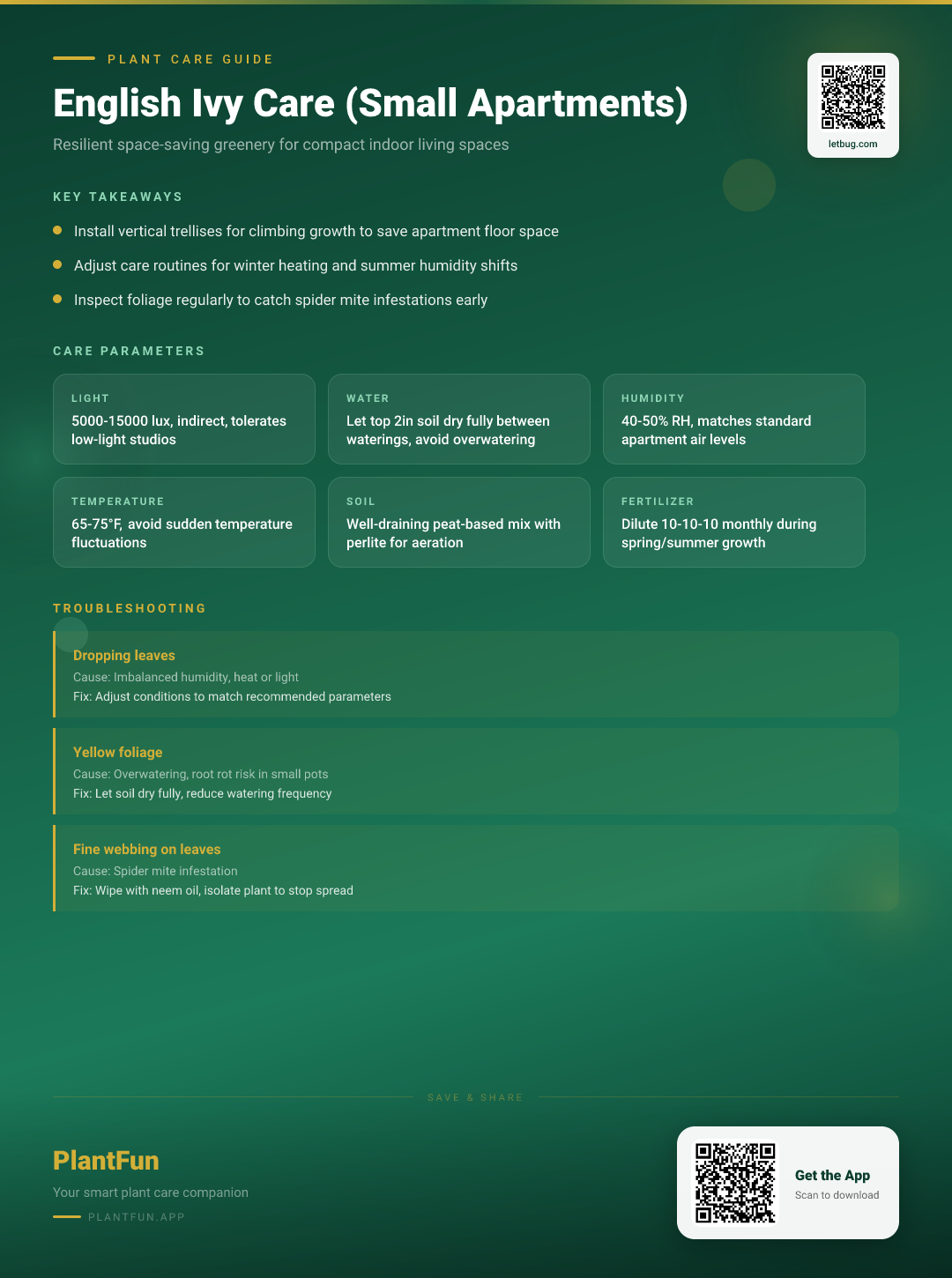
Key Takeaways
- Check soil moisture before watering — overwatering is the #1 killer of houseplants.
- Ensure your plant gets the right amount of light for its species.
- Be patient with recovery — most plants need 2–4 weeks to bounce back.
Quick Care Card: Essential Data for Rapid Reference
| Feature | Metric/Requirement |
|---|---|
| Light | 5,000–15,000 Lux (Bright, indirect) |
| Watering | Top 1-2 inches dry between waterings |
| Humidity | 40–50% (Ambient) |
| Temperature | 65–75°F (18–24°C) |
| Soil | Well-draining, peat-based mix |
| Fertilizer | Balanced liquid feed, monthly (Spring/Summer) |
| Toxicity | Toxic to cats and dogs (ASPCA, 2026) |
TL;DR: The 60-Second Ivy Apartment Survival Summary
English Ivy (Hedera helix) thrives in small apartments when you mimic its natural temperate environment. Focus on bright, indirect light (5,000–15,000 Lux), keep soil slightly moist but never waterlogged, and monitor for spider mites which thrive in dry apartment air. Prune regularly to manage growth patterns and maintain airflow. Always keep away from pets (ASPCA, 2026).
Why English Ivy is the Ultimate Small-Space Greenery: Benefits Beyond Aesthetics
When I first started my indoor jungle, I struggled with plants that demanded massive floor space. English Ivy is the exception. Its ability to grow vertically allows you to reclaim floor area. Beyond the visual appeal, it is a master of spatial optimization, easily trained to grow up bookshelves or across curtain rods, making it a staple for anyone mastering small apartment plant care.
The Lighting Equation: Managing 5,000–15,000 Lux in Limited Window Space
In my experience, Ivy is often sold as a “low light” plant, but that is a myth. While it survives, it thrives in 5,000–15,000 lux. A study on leaf variegation confirms that light intensity directly influences pigment health and growth vigor (Kim et al., 2012). If your apartment faces north or has limited window access, place your Ivy on a high shelf within 2 feet of the glass.
Irrigation & Humidity: Keeping Foliage Vibrant in 40–50% Apartment Air
I keep my Ivy on a strict “check before you splash” routine. Stick your finger 2 inches into the soil; if it feels dry, it is time to hydrate. In high-density living, central heating often drops humidity below 30%. Since Ivy prefers 40–50% (NC State Extension, 2026), I recommend keeping it away from heat vents to prevent crisping.
The Thermal sweet spot: Maintaining 65-75°F for consistent growth
Hedera helix prefers a stable environment. My apartment fluctuated too much until I moved my Ivy away from drafty windows and radiators. Maintaining 65–75°F ensures the internal cellular processes, such as nuclear division and growth cycles, remain consistent (Polito & Chang, 1984).
Step-by-Step: Managing Ivy Growth Patterns with Vertical Trellising
- Select a trellis: A small wooden or metal hoop fits perfectly into 6-inch pots.
- Clean the stems: Ensure vines are free of dust to maximize photosynthesis.
- Loop the vine: Gently wrap the trailing stem around the trellis.
- Secure: Use soft floral tape or green twist ties to hold the vine in place without restricting the stem.
- Prune: If a vine exceeds 24 inches, trim just above a node to encourage branching, a key skill for effective trailing plant care.
Why is my English Ivy dropping leaves? Solving the humidity-heat-light trio
Sudden Leaf Drop
Symptom: Leaves fall off in large numbers, often while still green.
Likely cause: Radical changes in temperature or light.
Fix:
- Move the plant to a spot with consistent, stable temperature.
- Check for cold drafts or direct heat sources nearby.
Yellowing Leaves
Symptom: Lower leaves turn yellow and drop.
Likely cause: Overwatering leading to root suffocation.
Fix:
- Let the soil dry out significantly more before the next watering.
- Ensure your pot has drainage holes to prevent standing water.
Can I keep my English Ivy in a low-light studio apartment?
While it will not die immediately, it will become “leggy”—stretching for light. You might need to supplement with a small LED grow bulb if your lux levels drop consistently below 3,000.
How do I know if my Ivy has spider mites?
Spider Mite Infestation
Symptom: Tiny webbing between leaves and speckled, pale foliage.
Likely cause: Dry, stagnant apartment air.
Fix:
- Isolate the plant immediately.
- Wipe leaves with a damp cloth to remove webs.
- Treat with horticultural soap or neem oil, ensuring you hit the undersides of the leaves.
Seasonal Adjustments: Managing the Ivy lifecycle from winter heating to summer growth
In winter, I reduce my watering by 30% because the plant enters a semi-dormant state. Conversely, during summer, I increase my indoor plant fertilization routine to support the rapid growth encouraged by higher light levels.
Common Mistakes: Avoiding the ‘overwatering trap’ in small pots
- Mistake: Watering on a calendar schedule.
- What happens: Root rot occurs because the soil stays perpetually damp.
- Instead: Water only when the top 2 inches of soil are dry.
References
- Kim, J., Kang, S., & Pak, C. (2012). Changes in Leaf Variegation and Coloration of English Ivy and Polka Dot Plant under Various Indoor Light Intensities. HortTechnology. https://doi.org/10.21273/horttech.22.1.49. Accessed 2026-03-17.
- Polito, V., & Chang, Y. (1984). Quantitative nuclear cytology of english ivy (Hedera helix L.). Plant Science Letters. https://doi.org/10.1016/s0304-4211(84)80017-6. Accessed 2026-03-17.
- ASPCA. (2026). Toxic and Non-Toxic Plants List — ASPCA. https://www.aspca.org/pet-care/animal-poison-control/toxic-and-non-toxic-plants. Accessed 2026-03-17.
- NC State Extension. (2026). English Ivy — NC State Extension Gardener Plant Toolbox. https://plants.ces.ncsu.edu/plants/ivy-care/. Accessed 2026-03-17.
Optional Helper: Plantfun.App
Plantfun.App identifies your plants by photo, diagnoses pests and diseases with clear fixes, and creates personalised watering and light schedules that adapt to your home conditions — a handy companion for putting this guide into daily practice.
Found an error or have suggestions? We'd love your feedback.
Need help identifying this problem?
Get instant identification, personalized care schedules, and effective pest treatment plans directly on your phone.
Sponsored • We may earn a commission from app downloads
Related Guides
English Ivy in Small Apartments: The Complete Care Guide for Resilient, Lush Growth
Transform your small apartment into a green oasis with our English Ivy care guide. Learn the exact light, humidity, and watering thresholds for resilient vines.
Care GuideEnglish Ivy in Small Apartments: The Ultimate Care Guide for Lush, Resilient Indoor Growth
Master your English Ivy care in tight apartment spaces. Learn exact lux, moisture, and rotation techniques to keep your vines lush without taking over your home.
Care GuideEnglish Ivy in Apartment Living: The Complete Care Guide for Year-Round Resilient Growth
Transform your apartment into a lush sanctuary. Master English Ivy care with our 4-season routine, light-lux requirements, and proven tips for pest-free growth.
Pest ControlAnts on Plants: What They Mean and What to Do
Ants usually aren't eating your plant. They are farming other pests.