
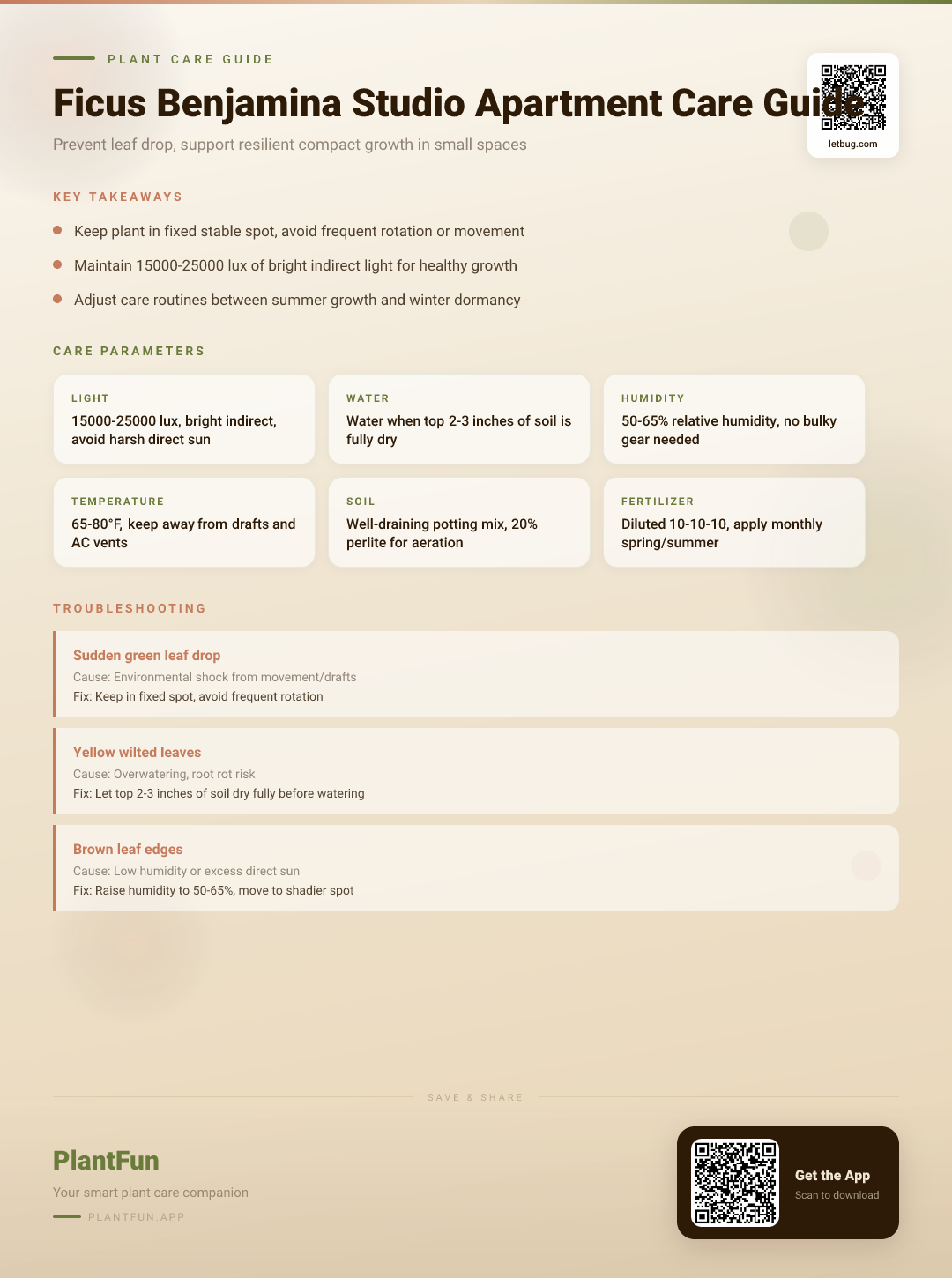
Key Takeaways
- Check soil moisture before watering — overwatering is the #1 killer of houseplants.
- Ensure your plant gets the right amount of light for its species.
- Be patient with recovery — most plants need 2–4 weeks to bounce back.
When I first brought a Ficus Benjamina into my 450-square-foot studio, I made the mistake of placing it right next to my radiator. Within three days, half the leaves littered my floor. That “weeping” reputation isn’t just a name—it’s a warning. In a small space, environmental stability is the only thing standing between a thriving tree and a bare twig.
Quick Care Card: Essential thresholds for the Ficus Benjamina
| Requirement | Threshold |
|---|---|
| Light | 15,000–25,000 lux |
| Water | Allow top 2 inches of soil to dry |
| Humidity | 50–65% |
| Temperature | 65–80°F |
| Soil | Well-draining, peat-based mix |
| Fertilizer | Balanced liquid 20-20-20 (monthly) |
| Toxicity | Toxic to cats and dogs (ASPCA, 2026) |
TL;DR: The golden rule for apartment-grown Ficus resilience
Consistency is king. The Ficus Benjamina thrives on stability; it detests sudden changes in light, temperature, or airflow. In a small apartment, keep it away from active AC vents, drafty windows, and high-traffic corners. If you find a spot where it stops dropping leaves, never move it again.
Why your Ficus Benjamina hates moving (and how to mitigate environmental shock)
These plants are genetically programmed to respond to light intensity shifts by shedding foliage to conserve energy. When you bring one home or move it across your apartment, you are forcing it to recalibrate its photosynthetic capacity. To mitigate shock, move the plant in increments over a week rather than all at once. If you’ve just purchased one, give it 14 days of “quarantine” in a single, stable spot before pruning or repotting.
Light Requirements: Hitting the 15,000–25,000 lux sweet spot in small spaces
According to the NC State Extension (2026), these plants require bright, indirect light to maintain their density. In a studio, you might lack a southern exposure, so I recommend using a light meter to ensure you hit at least 15,000 lux. If you are struggling with low light, place the Ficus within 3 feet of your brightest window, or supplement with a full-spectrum LED grow light for 8–10 hours a day.
Watering Mastery: Avoiding root rot in confined, low-airflow corners
In confined spaces, airflow is often lower, meaning soil stays wet longer. This creates a perfect environment for pathogens. As noted in research on the subject (Bolton, 1984), excess moisture and poor drainage are the primary drivers of root rot in Ficus.
- The Finger Test: Push your finger 2 inches into the soil. If it feels moist, do not water.
- Volume: Use room-temperature water. Pour until it drains from the bottom, then empty the saucer immediately. Never let the plant sit in standing water, as this invites fungal issues (Bolton, 1984).
Humidity & Airflow: Maintaining 50–65% humidity without bulky equipment
Small apartments dry out quickly, especially in winter. I maintain 50–65% humidity by grouping my Ficus with other foliage plants or placing it on a pebble tray filled with water. Avoid placing the plant directly in the line of a ceiling fan or AC unit, as direct, rapid airflow causes localized leaf desiccation.
The 65–80°F Temperature Rule: Why drafty windows and AC vents are your enemy
Ficus Benjamina prefer a steady 65–80°F. If your studio apartment experiences cold drafts from old window seals or rapid temperature spikes from heating units, the plant will react with immediate leaf drop. Use a thermometer to monitor the spot for 24 hours before making the area permanent.
Seasonal Shift: Adjusting your care routine from summer peak to winter dormancy
As daylight hours decrease, the plant enters a period of reduced growth. I cut back my watering by 30% during winter months to match the plant’s metabolic slow-down. If you keep your apartment at a steady 70°F year-round, you may not need to adjust as drastically, but always prioritize the soil-dryness check over a set schedule.
FAQ: Why is my Ficus Benjamina dropping green leaves suddenly?
This is almost always a sign of a sudden environmental shift—moving the plant, a change in light, or a cold draft. If the leaves are yellowing, check for overwatering. If they are green and dropping, look for a recent change in the plant’s location or temperature (NC State Extension, 2026).
FAQ: How do I prune a Ficus Benjamina to keep it compact for my apartment?
Pruning is essential for space control. In early spring, trim back the “leggy” terminal growth by 2–3 inches. This encourages lateral branching, which fills out the canopy and prevents the tree from hitting your ceiling or blocking your limited floor space.
FAQ: Can I put my Ficus on a balcony in the summer?
It is possible, but be warned: bringing it back inside will almost certainly cause another round of leaf drop due to the extreme change in light intensity. It is better to find one good spot and keep it there year-round.
Common Mistakes: Why you should never rotate your Ficus frequently
- Mistake: Rotating the plant 180 degrees every week to “even out” growth.
- What happens: The plant wastes massive energy reorienting its leaf solar panels to the light source, triggering stress-induced leaf drop.
- Instead: Rotate the pot only 45 degrees once a month, if necessary, and only during the active growing season.
References
- Bolton, A. (1984). Root Rot of Ficus benjamina. Plant Disease. https://doi.org/10.1094/pd-68-816. Accessed 2026-03-18.
- Bolton, A. (1984). Root Rot of Ficus benjamina. Plant Disease. https://doi.org/10.1094/pd-69-816. Accessed 2026-03-18.
- ASPCA. (2026). Toxic and Non-Toxic Plants List — ASPCA. https://www.aspca.org/pet-care/animal-poison-control/toxic-and-non-toxic-plants. Accessed 2026-03-18.
- NC State Extension. (2026). Ficus Benjamina — NC State Extension Gardener Plant Toolbox. https://plants.ces.ncsu.edu/plants/benjamina-care/. Accessed 2026-03-18.
Optional Helper: Plantfun.App
Plantfun.App identifies your plants by photo, diagnoses pests and diseases with clear fixes, and creates personalised watering and light schedules that adapt to your home conditions — a handy companion for putting this guide into daily practice.
Found an error or have suggestions? We'd love your feedback.
Need help identifying this problem?
Get instant identification, personalized care schedules, and effective pest treatment plans directly on your phone.
Sponsored • We may earn a commission from app downloads
Related Guides
Ficus Benjamina in a Studio Apartment: The Complete Care Guide for Resilient Growth
Stop your Ficus Benjamina from dropping leaves. Discover the exact light, water, and humidity protocols to keep your tree thriving in a small apartment.
Care GuideFicus Benjamina in Your Apartment: The Complete Seasonal Guide for Lush, Resilient Growth
Transform your Ficus Benjamina into a resilient apartment showpiece. Master exact light levels, precise watering cycles, and a 4-season care plan for healthy growth.
Care GuideThe Complete Ficus Benjamina Care Checklist for Resilient Growth in Typical Apartments
Stop losing Ficus Benjamina leaves to apartment stress. Get 4 actionable seasonal care routines, measurable light/water thresholds, and a free printable checklist to boost steady, resilient growth year-round.
Pest ControlAnts on Plants: What They Mean and What to Do
Ants usually aren't eating your plant. They are farming other pests.