
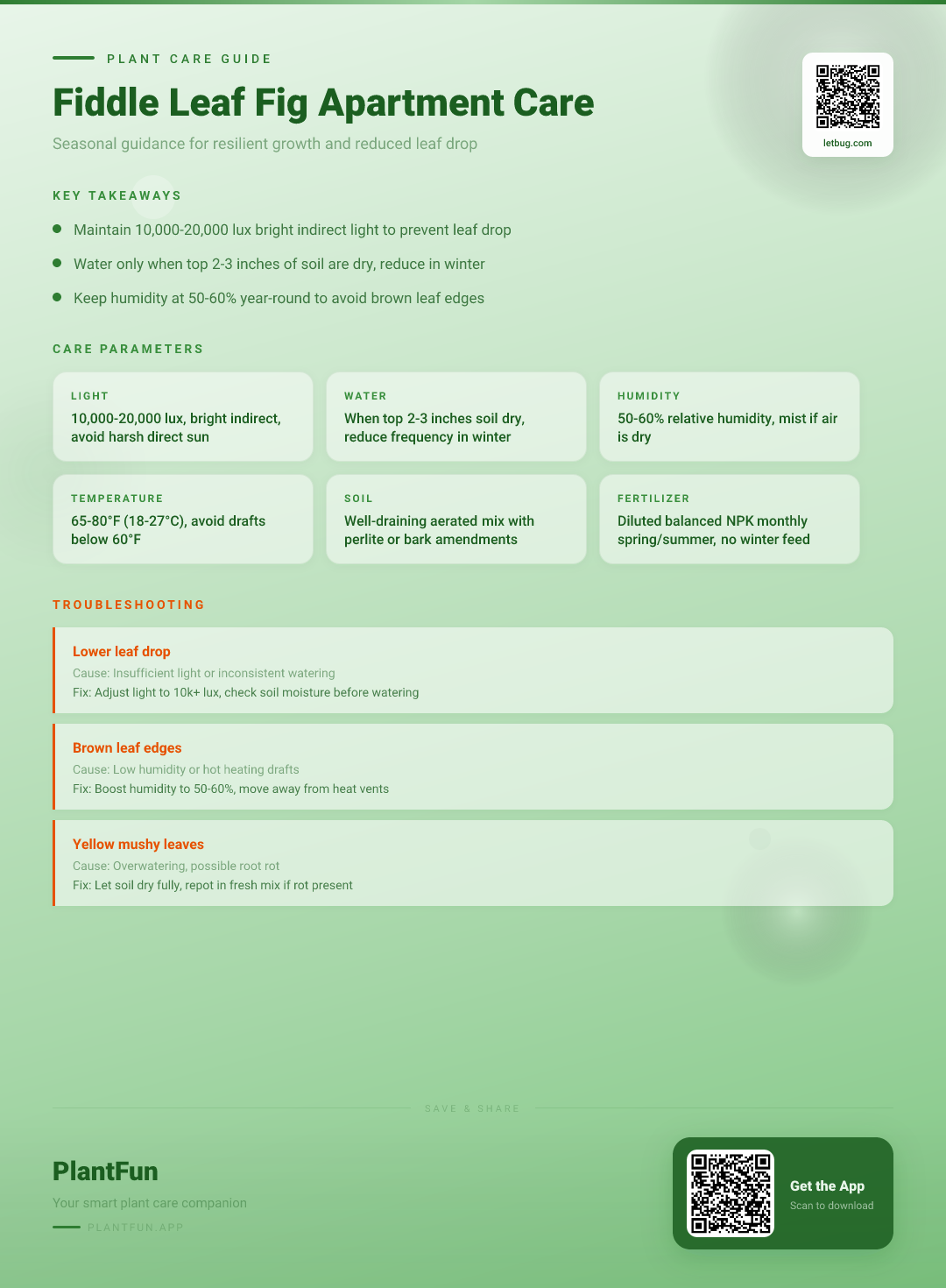
Key Takeaways
- Check soil moisture before watering — overwatering is the #1 killer of houseplants.
- Ensure your plant gets the right amount of light for its species.
- Be patient with recovery — most plants need 2–4 weeks to bounce back.
TL;DR: The Essentials
To keep your Fiddle Leaf Fig (Ficus lyrata) thriving in an apartment, place it in bright, indirect light (10,000–20,000 lux). Water only when the top 2 inches of soil are dry to the touch. Maintain ambient temperatures between 65-80°F (18-27°C) and indoor humidity levels of 50-60%. Always use a well-draining soil mix to prevent root rot.
Quick Care Card: Essential Data
| Feature | Requirement |
|---|---|
| Light | Bright, indirect (10,000-20,000 lux) |
| Water | When top 2” of soil are dry |
| Humidity | 50-60% |
| Temperature | 65-80°F (18-27°C) |
| Soil | Chunky, well-draining aroid mix |
| Fertilizer | Balanced liquid feed during growing season |
| Toxicity | Toxic to cats and dogs (ASPCA, 2026) |
Why Your Fiddle Leaf Fig Struggles in Apartment Micro-climates
When I first brought my Fiddle Leaf Fig home, I placed it in a dim corner, assuming it would adapt. It promptly dropped three leaves. I learned the hard way that apartments create unique micro-climates—specifically, erratic HVAC airflow and lack of consistent light. Unlike a greenhouse, an apartment has “dead zones” where air stagnates or gets blasted by heat vents. These plants require stability to perform photosynthesis efficiently (PlantwisePlus Knowledge Bank, 2022).
Seasonal Care Calendar: Adjusting Your Routine
- Spring/Summer (Growth Phase): Increase watering frequency as metabolic rates rise. Apply a balanced fertilizer monthly. Rotate the plant 90 degrees every two weeks to ensure even light exposure.
- Fall/Winter (Dormancy Phase): Growth slows down significantly. Reduce watering—wait until the top 3 inches are dry. Stop fertilizing entirely from November to February (NC State Extension, 2026).
Measuring Light: How to Hit the 10,000-20,000 Lux Sweet Spot
Fiddle Leaf Figs aren’t low-light plants. They crave high-intensity light without direct, scorching sun. I use a simple light meter app on my phone to check if my plant is getting 10,000–20,000 lux. If you don’t have a meter, ensure the plant can “see” a large portion of the sky through a window without the sun hitting its leaves directly.
Watering Mastery: Using Moisture Sensors and the Finger-Test Method
Forget the “once a week” rule; it’s a recipe for root rot. Instead, use the finger-test: stick your finger 2 inches into the soil. If it feels moist, wait. If it’s dry, water thoroughly until liquid drains from the bottom. Proper soil drainage is critical to avoid waterlogging the root system (NC State Extension, 2026).
Managing Humidity: Keeping Levels Between 50-60% in Dry Apartment Air
Apartment air, especially in winter, often drops below 30% humidity. This causes the edges of leaves to crisp. I keep a humidifier nearby or group my plants together to create a micro-climate with 50-60% relative humidity. Cleaning the leaves with a damp cloth every few weeks is also essential for gas exchange (PlantwisePlus Knowledge Bank, 2022).
Temperature Control: Avoiding Drafts
Keep your plant away from AC vents and radiators. A constant 65-80°F (18-27°C) is ideal. Sudden drops or spikes in temperature are a primary cause of physiological stress in Ficus lyrata.
Frequently Asked Questions
- Why is my Fiddle Leaf Fig losing its lower leaves? This is often a sign of overwatering or inadequate light. Check for wet, soggy soil.
- How often should I water my Fiddle Leaf Fig in the winter? Less frequently than in summer. Use the finger-test and wait for the top 3 inches of soil to dry out.
- Can I put my Fiddle Leaf Fig in a bathroom? Only if there is a window. High humidity is great, but lack of light will kill it.
- Is my plant dangerous to my pets? Yes, the ASPCA classifies Ficus lyrata as toxic to cats and dogs (ASPCA, 2026).
Common Mistakes to Avoid
- Mistake: Using dense potting soil. What happens: Water retention leads to root rot. Instead: Use an aroid mix with bark, perlite, and coco coir.
- Mistake: Frequent repotting. What happens: The plant goes into shock. Instead: Repot only when roots are circling the base, usually every 2 years.
When to Call a Pro: Identifying Signs of Root Rot and Pests
Root Rot
Symptom: Leaves show dark brown/black spots, and the stem feels soft.
Likely cause: Overwatering or poor drainage.
Fix:
- Unpot the plant to inspect roots; trim any mushy, black roots.
- Repot in fresh, dry, fast-draining substrate.
References
- PlantwisePlus Knowledge Bank. (2022). Ficus lyrata (fiddle-leaf fig). https://doi.org/10.1079/pwkb.species.24125. Accessed 2026-03-16.
- Astuti, E.; Mufrodi, Z. (2019). The Utilization of Fiddle-Leaf Fig Waste Into Food Preservative. Jurnal Bahan Alam Terbarukan. https://doi.org/10.15294/jbat.v8i1.19859. Accessed 2026-03-16.
- ASPCA. (2026). Toxic and Non-Toxic Plants List — ASPCA. https://www.aspca.org/pet-care/animal-poison-control/toxic-and-non-toxic-plants. Accessed 2026-03-16.
- NC State Extension. (2026). Fiddle Leaf Fig — NC State Extension Gardener Plant Toolbox. https://plants.ces.ncsu.edu/plants/fig-care/. Accessed 2026-03-16.
Optional Helper: Plantfun.App
Plantfun.App identifies your plants by photo, diagnoses pests and diseases with clear fixes, and creates personalised watering and light schedules that adapt to your home conditions — a handy companion for putting this guide into daily practice.
Found an error or have suggestions? We'd love your feedback.
Need help identifying this problem?
Get instant identification, personalized care schedules, and effective pest treatment plans directly on your phone.
Sponsored • We may earn a commission from app downloads
Related Guides
Fiddle Leaf Fig in a Dim Apartment: The Budget-Friendly Strategy for Resilient Growth
Transform your struggling Fiddle Leaf Fig into a resilient giant. Master precise watering, light placement, and budget-friendly feeding to see vibrant new growth.
Care GuideThe Complete Fiddle Leaf Fig Care Checklist for Resilient Growth in Small Urban Apartments
Stop guessing at Fiddle Leaf Fig care for your small urban apartment. Get 7 actionable, measurable checklist items that prevent leaf drop and promote lush, resilient growth all year long.
Care GuideFiddle Leaf Fig in Apartments: The Only Care Guide for Resilient, Steady Growth
Revive your Fiddle Leaf Fig with our apartment-proven guide. Get precise light levels, watering schedules, and 3 expert fixes for stubborn indoor leaf drop.
Pest ControlAnts on Plants: What They Mean and What to Do
Ants usually aren't eating your plant. They are farming other pests.