
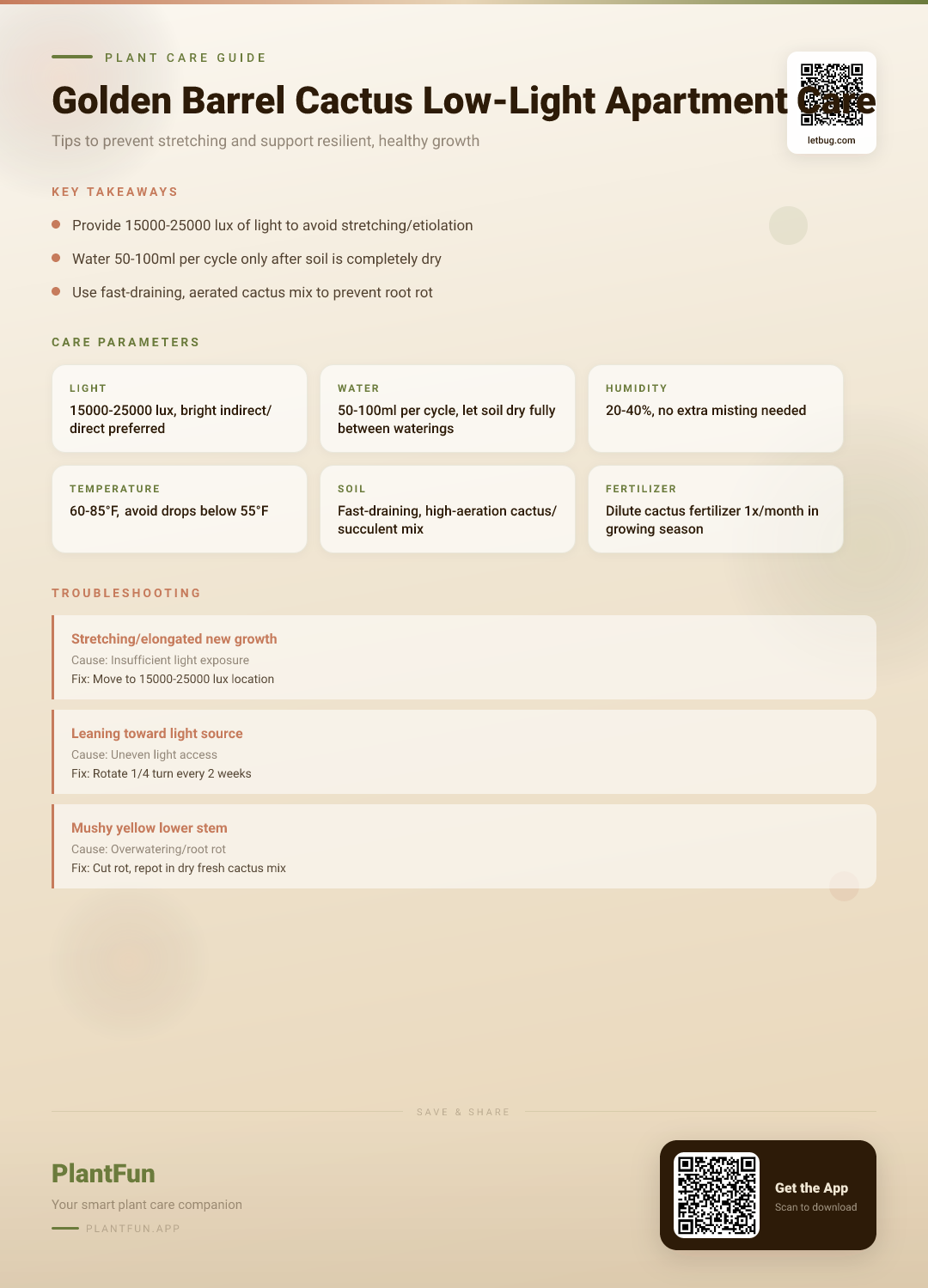
Key Takeaways
- Check soil moisture before watering — overwatering is the #1 killer of houseplants.
- Ensure your plant gets the right amount of light for its species.
- Be patient with recovery — most plants need 2–4 weeks to bounce back.
Quick Care Card: Essential Data
| Feature | Requirement |
|---|---|
| Light | 15,000–25,000 lux |
| Water | 50–100ml per cycle (drench and dry) |
| Humidity | 20–40% |
| Temperature | 60–85°F |
| Soil | Inorganic, grit-heavy mix |
| Fertilizer | Low-nitrogen succulent feed (seasonal) |
| Toxicity | Non-toxic to humans; sharp spines are a physical hazard |
TL;DR: The Reality of Cactus Growth in Apartments
When I first bought my Echinocactus grusonii, I placed it on a north-facing bookshelf. Within months, it transformed from a compact sphere into a pale, elongated column. Keeping a desert plant indoors requires mimicking its arid environment. In an apartment, this means providing intense, direct light, limiting water to prevent rot, and using high-drainage substrates. If you cannot provide 15,000+ lux, you must use a supplemental grow light to keep your cactus healthy.
Why Your Echinocactus grusonii is Struggling: The Low-Light Myth
Many beginners believe that because cacti grow in deserts, they are “tough” and can survive anywhere. This is a dangerous myth. In their native habitats, they receive nearly unobstructed solar radiation (NC State Extension, 2026). In an apartment, even a “bright” window often filters out 70% of available light. When the plant doesn’t get enough energy, it enters a state of etiolation—stretching toward the light source, losing its signature barrel shape, and weakening its structural integrity (Roberts, 2010).
Setting Your Light Thresholds: Measuring Lux for Healthy Spines
“Bright, indirect light” is a trap for desert cacti. To maintain dense spine growth, you need to hit at least 15,000 lux. I use a simple light-meter app on my phone to test my windowsill throughout the day. If your readings drop below 10,000 lux for most of the day, your plant is effectively “starving.” If you notice the green tissue turning pale or the spines becoming brittle, your light levels are insufficient.
The 50-100ml Watering Rule: Avoiding Substrate Saturation
Overwatering is the fastest way to kill a Golden Barrel (Polizzi & Vitale, 2004). My rule is simple: treat water like a limited resource. Using a graduated measuring cup, I provide 50–100ml of water only when the soil is completely dry.
- Use a moisture meter or a wooden skewer to check 2 inches into the soil.
- If it is damp, wait another week.
- When bone-dry, pour exactly 50-100ml at the base—never overhead, to avoid rot in the crown.
Step-by-Step: The Soil Mix for Drainage and Aeration
Standard potting soil is too moisture-retentive. I mix my own “grit-blend” to ensure air reaches the roots, which is crucial for preventing pathogens (Polizzi & Vitale, 2004).
- 40% Horticultural Grade Pumice (for drainage)
- 40% Coarse Sand (for structure)
- 20% Peat-free Cactus Compost (for nutrients)
Seasonal Shifts: How to Adjust Care from Summer to Winter
During summer, I increase my watering frequency slightly if the plant is warm (80°F+). However, in winter, I move my cactus to a cooler spot (around 60°F) and almost completely stop watering. This mimics the plant’s natural dormancy period, preventing the soft growth that occurs when plants are kept warm and dark during winter months (Roberts, 2010).
Common Mistakes to Avoid: From Over-misting to Static Placement
- Mistake: Misting the cactus like a tropical plant.
- What happens: Fungal spores settle on the moist epidermis and rot begins.
- Instead: Keep the plant dry and provide airflow.
- Mistake: Never rotating the pot.
- What happens: The plant leans aggressively toward the light.
- Instead: Give the pot a 90-degree turn every time you water.
Voice Search FAQ
How do I know if my cactus is getting enough light?
Look at the top of the cactus. If the new growth is significantly lighter in color or the spines are spaced wider apart than the older growth, it needs more light. Healthy spines should be dense and tightly packed.
Can I keep my Golden Barrel Cactus in a room without windows?
No. Without natural or high-intensity LED light, the plant will etiolate rapidly. It is not an indoor “low-light” plant and will eventually decline and die in a windowless room.
Why is my cactus leaning toward the wall?
This is phototropism. The cactus is attempting to reach a higher concentration of light. Rotate the plant frequently and move it closer to the window.
Troubleshooting Guide: Identifying Early Signs of Etiolation
Soft, Mushy Base
Symptom: The base of the stem feels squishy rather than firm.
Likely cause: Overwatering has led to basal stem rot (Polizzi & Vitale, 2004).
Fix:
- Remove the plant from the pot and inspect the roots for dark, slimy growth.
- Trim away rotten tissue and repot in dry, sterile soil.
Stretching/Narrowing Top
Symptom: The plant looks like it is “stretching” or narrowing at the top.
Likely cause: Insufficient light (etiolation).
Fix:
- Move the plant to a south-facing window immediately.
- Introduce a dedicated LED grow light to ensure 15,000+ lux.
Yellowing/Browning Skin
Symptom: The green skin turns yellow or develops brown, corky patches.
Likely cause: Sunburn from sudden exposure or pest stress.
Fix:
- If transitioning to brighter light, do so over 2 weeks to let the plant acclimate.
- Check for spider mites, which can cause surface discoloration.
References and Botanical Guidelines
- Polizzi, G., & Vitale, A. (2004). First Report of Basal Stem Rot of Golden Barrel Cactus Caused by Fusarium oxysporum f. sp. opuntiarum in Italy. Plant Disease. https://doi.org/10.1094/pdis.2004.88.1.85a. Accessed 2026-03-19.
- Roberts, E. (2010). Cactus Tips from a Master Grower. Cactus and Succulent Journal. https://doi.org/10.2985/015.082.0109. Accessed 2026-03-19.
- ASPCA. (2026). Toxic and Non-Toxic Plants List — ASPCA. https://www.aspca.org/pet-care/animal-poison-control/toxic-and-non-toxic-plants. Accessed 2026-03-19.
- NC State Extension. (2026). Golden Barrel Cactus — NC State Extension Gardener Plant Toolbox. https://plants.ces.ncsu.edu/plants/cactus-care/. Accessed 2026-03-19.
Optional Helper: Plantfun.App
Plantfun.App identifies your plants by photo, diagnoses pests and diseases with clear fixes, and creates personalised watering and light schedules that adapt to your home conditions — a handy companion for putting this guide into daily practice.
Found an error or have suggestions? We'd love your feedback.
Need help identifying this problem?
Get instant identification, personalized care schedules, and effective pest treatment plans directly on your phone.
Sponsored • We may earn a commission from app downloads
Related Guides
Echinocactus Grusonii in a Low-Light Apartment: The Complete Resilient Growth Care Plan
Revive your Golden Barrel cactus with this science-backed growth plan. Learn exact light, soil, and water thresholds to prevent stretching in your apartment.
Care GuideGolden Barrel Cactus in a Low-Light Apartment: Why Your Plant Stretches and How to Stop It
Rescue your stretching Golden Barrel Cactus with our 4-step light correction plan. Learn exactly how to adjust your home environment for healthy, stout growth.
Care GuideGolden Barrel Cactus in a South-Facing Apartment: The Only Care Guide You’ll Ever Need
Master Golden Barrel cactus care with our precise 3-step watering schedule and light mapping. Keep your desert jewel thriving with 20,000+ lux and expert tips.
Pest ControlAnts on Plants: What They Mean and What to Do
Ants usually aren't eating your plant. They are farming other pests.