
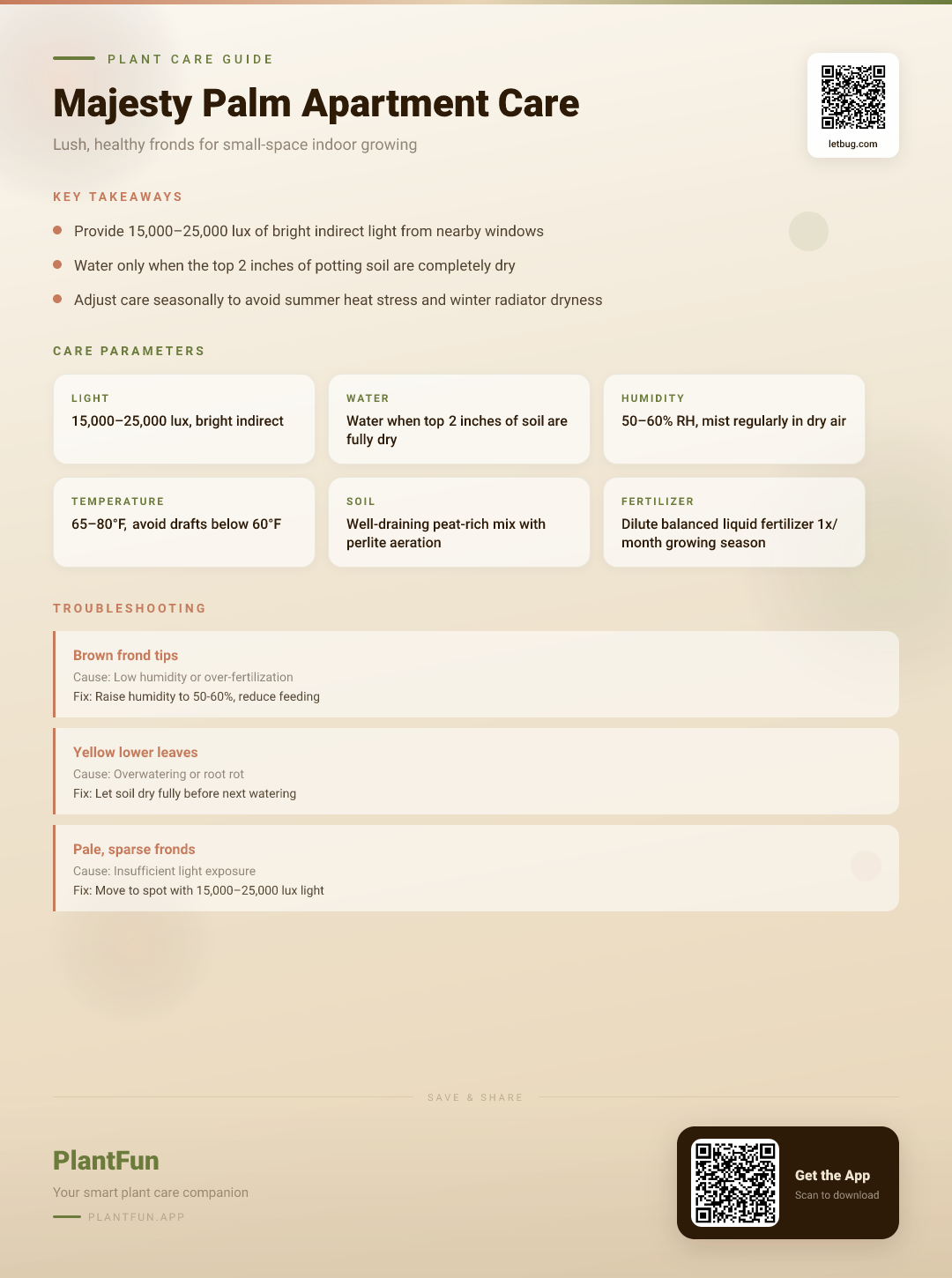
Key Takeaways
- Check soil moisture before watering — overwatering is the #1 killer of houseplants.
- Ensure your plant gets the right amount of light for its species.
- Be patient with recovery — most plants need 2–4 weeks to bounce back.
Quick Care Card: Essential Thresholds for Apartment Majesty Palms
| Feature | Requirement |
|---|---|
| Light | 15,000–25,000 Lux (Bright, indirect light) |
| Water | Keep evenly moist; allow top 2 inches to dry |
| Humidity | 50–60% (Use a humidifier) |
| Temperature | 65–80°F (18–27°C) |
| Soil | Well-draining, peat-based mix |
| Fertilizer | Balanced liquid feed, monthly in growing season |
| Toxicity | Non-toxic to pets (ASPCA, 2026) |
TL;DR: Why Majesty Palms Struggle in Small Apartments
Majesty Palms (Ravenea rivularis) are often sold as “easy” indoor plants, but in an apartment, they are actually high-performance specimens. Their decline is usually caused by a “triple threat”: insufficient light levels below 15,000 lux, stagnant air that prevents transpiration, and chronic underwatering. If you can bridge the gap between your living room and their native riparian habitat, they will thrive.
Natural Habitat vs. The Living Room Corner: Understanding The Gap
When I first got my Majesty Palm, I placed it in a dim corner, thinking it was a typical tropical shade plant. I was wrong. In their native Madagascar, these palms grow along riverbanks in full, intense sun (NC State Extension, 2026). When we tuck them into an apartment corner, we are asking them to survive on a fraction of the photons they crave. Understanding this habitat gap is the secret to moving from “survival” to “growth.”
Light Requirements: Achieving 15,000–25,000 Lux in Limited Windows
Most apartments rarely reach the intensity this palm needs. You should aim for 15,000–25,000 lux (NC State Extension, 2026). If you aren’t sure, download a light meter app or observe your plant: if the fronds reach desperately toward the window, it needs more light. I recommend placing your palm within three feet of a south or west-facing window. If that isn’t possible, a supplemental full-spectrum grow light can provide the necessary energy to prevent leaf drop.
Watering Mastery: Why ‘Top 2 Inches Dry’ is Your Best Friend
Many beginners make the mistake of letting their palm dry out completely. Because these plants naturally inhabit wet soil environments, a total drought will kill the root tips. Use the “finger test”: stick your finger 2 inches into the soil. If it feels slightly dry, it is time to water. Consistency is key, as the roots do not respond well to dramatic fluctuations in moisture (NC State Extension, 2026).
Humidity Hacks: Reaching 50–60% in Dry Apartment Air
In urban apartments, indoor heating or air conditioning often drops humidity to 20–30%. This is the primary reason for crisp, brown foliage. To keep your plant happy, you need to elevate localized humidity to 50–60%. I use a small ultrasonic humidifier aimed toward the foliage, or a pebble tray filled with water to boost the moisture right where the plant needs it most.
Temperature Management: Keeping Your Palm Between 65-80°F
Majesty palms prefer a steady 65–80°F (NC State Extension, 2026). Avoid placing them near radiators or direct AC vents, as the rapid temperature shift can stress the plant and make it vulnerable to pathogens like Botrytis (Polizzi, 2002).
Can I keep my Majesty Palm in a dim apartment corner?
Strictly speaking, no. While it may stay alive for a few months, it will eventually lose fronds and become prone to pests. If you have a dim apartment, you must provide a grow light. For more tips on managing light, check out our guide to indoor plant lighting solutions.
Why is my Majesty Palm getting brown tips even with regular watering?
Brown tips are often a cry for higher humidity. When the air is too dry, the plant loses moisture faster through its fronds than the roots can replace it. Ensure your humidity is at least 50%. It can also be a sign of salt buildup from tap water; try switching to distilled water for a month.
How do I prevent my palm from outgrowing my living room space?
Majesty palms are naturally large, but you can control growth by keeping them slightly root-bound. Avoid frequent repotting. When you do repot, use a high-quality well-draining potting mix to ensure long-term health.
Seasonal Care Calendar: Adjusting for Summer Heat and Winter Radiators
- Spring/Summer: Increase watering as temperatures rise. Apply a balanced liquid fertilizer monthly to support new frond development.
- Fall/Winter: Growth slows down. Reduce watering, but monitor humidity closely, as radiators dry out the air significantly. Keep the plant away from drafty windows.
Common Mistakes: The Top 3 Reasons Majesty Palms Fail Indoors
- Mistake: Letting the soil go bone-dry. What happens: Root desiccation and permanent leaf damage. Instead: Keep the soil consistently damp but never waterlogged.
- Mistake: Placing in a “low light” corner. What happens: Stunted growth and yellowing fronds. Instead: Maximize natural window light or use a dedicated grow light.
- Mistake: Ignoring humidity. What happens: Browning, crispy edges on every leaf. Instead: Group with other plants or use a humidifier.
References
- Polizzi, G. (2002). Severe Outbreak of Leaf Spot and Blight Caused by Botrytis cinerea on Majesty Palm in Southern Italy. Plant Disease. https://doi.org/10.1094/pdis.2002.86.7.815b. Accessed 2026-03-18.
- Polizzi, G., & Vitale, A. (2003). First Report of Fusarium Blight on Majesty Palm Caused by Fusarium proliferatum in Italy. Plant Disease. https://doi.org/10.1094/pdis.2003.87.9.1149a. Accessed 2026-03-18.
- ASPCA. (2026). Toxic and Non-Toxic Plants List — ASPCA. https://www.aspca.org/pet-care/animal-poison-control/toxic-and-non-toxic-plants. Accessed 2026-03-18.
- NC State Extension. (2026). Majesty Palm — NC State Extension Gardener Plant Toolbox. https://plants.ces.ncsu.edu/plants/majesty-palm/. Accessed 2026-03-18.
Optional Helper: Plantfun.App
Plantfun.App identifies your plants by photo, diagnoses pests and diseases with clear fixes, and creates personalised watering and light schedules that adapt to your home conditions — a handy companion for putting this guide into daily practice.
Found an error or have suggestions? We'd love your feedback.
Need help identifying this problem?
Get instant identification, personalized care schedules, and effective pest treatment plans directly on your phone.
Sponsored • We may earn a commission from app downloads
Related Guides
Majesty Palm in a Low-Humidity Apartment: The Only Care Guide You’ll Ever Need
Stop the brown tips on your Majesty Palm. Master exact lux requirements, specific watering schedules, and humidity hacks for dry apartments. Grow lush palms today.
Care GuideMajesty Palm in Low-Humidity Apartments: 8-Step Checklist for Resilient Year-Round Growth
Stop watching your majesty palm turn brown in your dry apartment. Use our 8-step science-backed checklist for consistent, resilient frond growth all year long, no fancy tools required.
Care GuideThe Complete Majesty Palm Care Checklist for Resilient Growth in Typical Apartments
Stop watching your majesty palm wilt or develop brown tips in your apartment. Get exact light levels, humidity targets, and a printable 10-step checklist for lush, resilient growth all year long.
Pest ControlAnts on Plants: What They Mean and What to Do
Ants usually aren't eating your plant. They are farming other pests.