
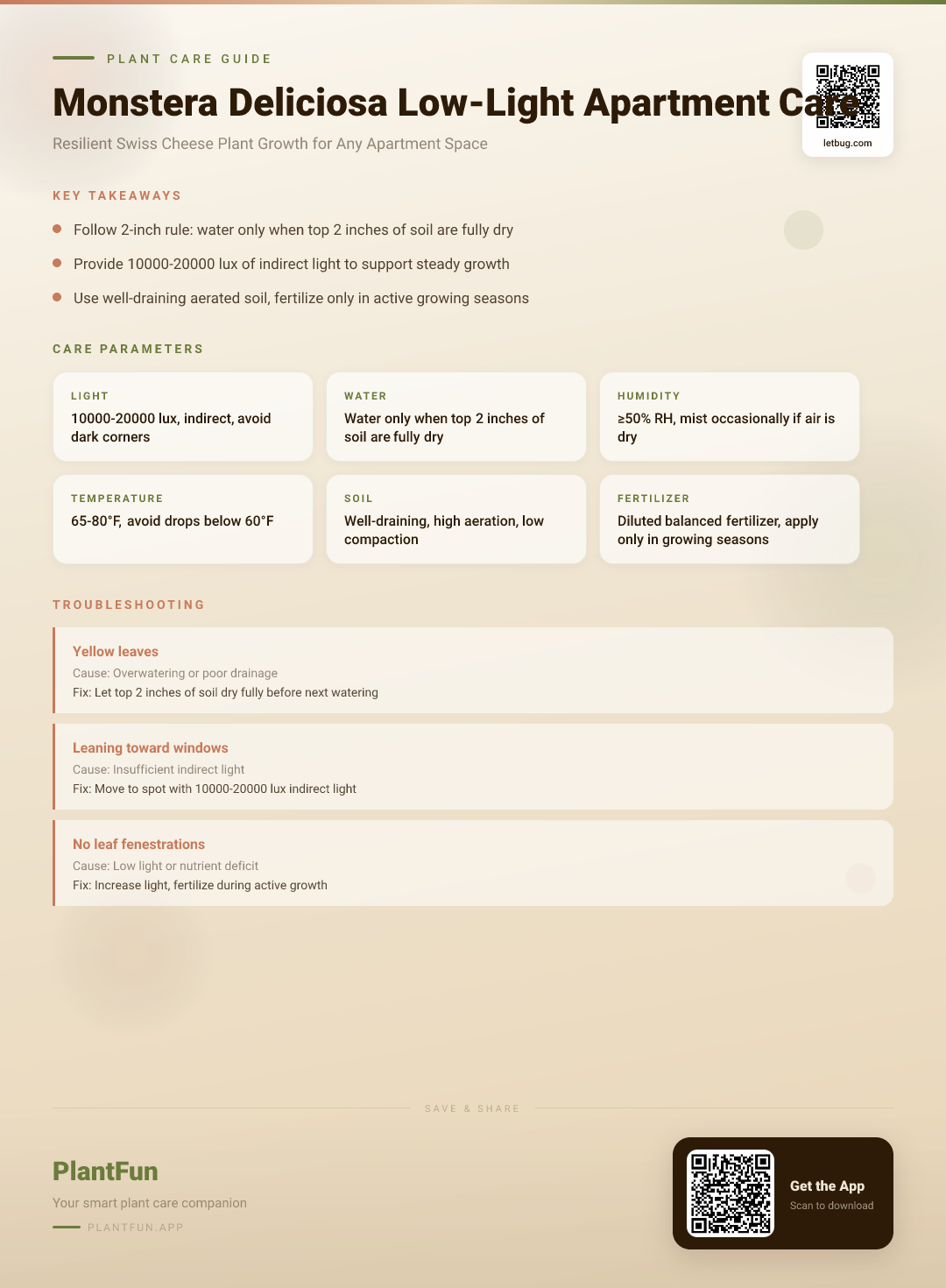
Key Takeaways
- Check soil moisture before watering — overwatering is the #1 killer of houseplants.
- Ensure your plant gets the right amount of light for its species.
- Be patient with recovery — most plants need 2–4 weeks to bounce back.
TL;DR: Quick Summary
To keep your Monstera deliciosa thriving in an apartment, prioritize bright, indirect light (10,000–20,000 lux) and allow the top two inches of soil to dry before watering. Avoid low-light corners, which cause leggy, fenestration-free growth. Ensure your potting mix is well-aerated with perlite or orchid bark to prevent root rot, and keep your plant away from curious pets, as it is toxic (ASPCA, 2026).
Quick Care Card: Essential Thresholds for Your Monstera
| Requirement | Optimal Range |
|---|---|
| Light | 10,000–20,000 Lux (Bright Indirect) |
| Water | Allow top 2” of soil to dry |
| Humidity | Above 50% RH |
| Temperature | 65°F–80°F (18°C–27°C) |
| Soil | Chunky, well-draining aroid mix |
| Fertilizer | Balanced liquid feed, monthly during growth |
| Toxicity | Toxic to cats and dogs (ASPCA, 2026) |
My Experience: The “Dark Corner” Mistake
When I first got my Monstera deliciosa, I placed it in a trendy, dark corner of my studio apartment, thinking it would add a “jungle vibe.” Within two months, the stems stretched out thin, the leaves remained small and solid (no fenestrations), and the lower leaves began yellowing. I learned the hard way: Monstera are not true shade plants. They are epiphytes that crave filtered forest-floor light. Once I moved mine within three feet of a south-facing window, the growth pattern transformed, and new leaves finally emerged with those iconic splits.
Understanding Your Monstera’s Light Needs (10,000-20,000 Lux)
Light is the primary engine for your plant’s photosynthesis. If you are struggling with low light monstera care, it is likely because your light levels fall below 10,000 lux. In an apartment, use a light meter app on your phone to check the levels near your plant. If you find your plant isn’t getting enough, moving it closer to a window or adding a high-output LED grow light can prevent the “leggy” behavior common in indoor settings (NC State Extension, 2026).
The 2-Inch Rule: Watering Your Monstera in Apartment Conditions
Many beginners ask, “how often to water monstera?” The answer isn’t a specific day of the week, but a moisture test. Stick your finger two inches into the soil. If it feels damp, wait. If it feels dry, it is time to water. This prevents the primary cause of death for indoor plants: root rot caused by stagnant water (NC State Extension, 2026).
Humidity & Temperature: Keeping Your Plant Above 50% RH and 65-80°F
Monstera thrive in warm, humid environments. Apartment living, especially in winter, often features dry air from radiators. Aim for at least 50% relative humidity (RH). Using a pebble tray or a small humidifier near your plant can significantly improve foliage health and prevent browning tips.
Section 1: Why Your Monstera is Failing in a Dark Corner
When light is insufficient, the plant undergoes etiolation—it stretches its stems, searching for a light source. This weakens the plant’s structural integrity. Furthermore, in lower light, the plant transpires less, meaning it uses water slowly. If you water on a strict schedule rather than by soil moisture, the roots will remain in wet soil for too long, leading to decay.
Section 2: Soil Amendments for Superior Drainage and Aeration
The best soil for swiss cheese plant health is not a dense potting mix. I mix 50% standard indoor potting soil with 25% chunky perlite and 25% coco chips or bark. This creates the oxygen pockets roots need to breathe.
Section 3: Seasonal Adjustments: Managing Winter Dormancy and Summer Growth
During winter, your Monstera slows down. Reduce your watering frequency significantly. Because light levels are lower, the plant needs less fuel. Resume your normal, slightly more frequent watering schedule only when you see signs of new growth in the spring.
Section 4: The 5-Step Routine for Fertilizing Indoor Monsteras
- Use a balanced, water-soluble fertilizer.
- Dilute the fertilizer to half-strength to avoid root burn.
- Apply only during the active growing season (Spring/Summer).
- Water the plant first to ensure the roots are not dry.
- Flush the pot with clear water once every few months to remove mineral buildup.
Section 5: Troubleshooting: Why are my Monstera leaves turning yellow?
Root Suffocation
Symptom: Lower leaves turning yellow and mushy.
Likely cause: Overwatering leading to root rot.
Fix:
- Remove the plant from the pot and inspect the roots.
- Trim away any black, slimy, or foul-smelling roots.
- Repot in fresh, sterile, well-draining soil.
Nutrient Deficiency
Symptom: Yellowing starting from older leaves while new growth remains small.
Likely cause: Lack of nitrogen or micronutrients.
Fix:
- Apply a balanced indoor fertilizer.
- Check that the soil is not so old that it has lost its nutrient value.
FAQ
- Why is my Monstera leaning toward the window? This is phototropism—your plant is physically growing toward the light source. Rotate your pot 90 degrees every time you water to ensure even growth.
- Can I tell if my plant needs more light? Yes, if the internodal spaces (the distance between leaves) are getting longer or if new leaves appear without fenestrations, it is starving for light.
- Can I use tap water for my Swiss Cheese Plant? Yes, though I prefer letting my tap water sit out for 24 hours to let chlorine dissipate. If you notice white spots on the leaves, you may have hard water, which can affect nutrient uptake (Haydon & Shaw, 1991).
Common Mistakes: Overpotting and Watering Schedules
- Mistake: Putting a small plant in a massive pot.
- What happens: The soil holds too much water, inviting root rot.
- Instead: Only increase the pot size by 1–2 inches in diameter.
- Mistake: Watering on a calendar schedule.
- What happens: You ignore the plant’s actual water needs based on current light and temperature.
- Instead: Use the finger-test method before every watering.
References: Botanical Standards for Monstera Deliciosa
- Haydon, G.; Shaw, D. (1991). Zinc Accumulation in Monstera Deliciosa Near Brisbane. Australasian Plant Pathology. https://doi.org/10.1071/app9910125. Accessed 2026-03-17.
- Shaw, D. (1992). Abnormal Internal Sori of Puccinia Paullula F.sp. Monsterae on Monstera Deliciosa. Australasian Plant Pathology. https://doi.org/10.1071/app9920123. Accessed 2026-03-17.
- ASPCA. (2026). Toxic and Non-Toxic Plants List — ASPCA. https://www.aspca.org/pet-care/animal-poison-control/toxic-and-non-toxic-plants. Accessed 2026-03-17.
- NC State Extension. (2026). Monstera Deliciosa — NC State Extension Gardener Plant Toolbox. https://plants.ces.ncsu.edu/plants/monstera-deliciosa/. Accessed 2026-03-17.
Optional Helper: Plantfun.App
Plantfun.App identifies your plants by photo, diagnoses pests and diseases with clear fixes, and creates personalised watering and light schedules that adapt to your home conditions — a handy companion for putting this guide into daily practice.
Found an error or have suggestions? We'd love your feedback.
Need help identifying this problem?
Get instant identification, personalized care schedules, and effective pest treatment plans directly on your phone.
Sponsored • We may earn a commission from app downloads
Related Guides
Monstera Deliciosa in Apartment Living: The Resilient Growth Guide for Consistent, Lush Foliage
Unlock lush Monstera growth in your apartment. Master seasonal watering, specific light thresholds, and foliage care to keep your plant vibrant all year round.
Care GuideThe Complete Monstera Deliciosa Care Guide for Apartment Living: Light, Water, Soil & More
Master Monstera deliciosa care in your apartment with our 4-step growth checklist. Get precise light, humidity, and water settings for a thriving, space-saving plant.
Care GuideMonstera Deliciosa in a Typical Apartment: The Only Resilience Care Guide You Need
Revive your Monstera with precise, apartment-friendly care. Learn exact lux needs, 7-day watering intervals, and how to prevent brown edges for lush growth.
Pest ControlHow to Spot Early Pest Signs on Your Monstera Deliciosa: A Weekly Inspection & Rescue Plan
Catch Monstera deliciosa pest infestations before they permanently damage your prized fenestrated leaves. Get a 5-minute weekly inspection routine, easy-to-spot early warning signs, and non-toxic rescue steps you can implement today to stop spread to other houseplants.