
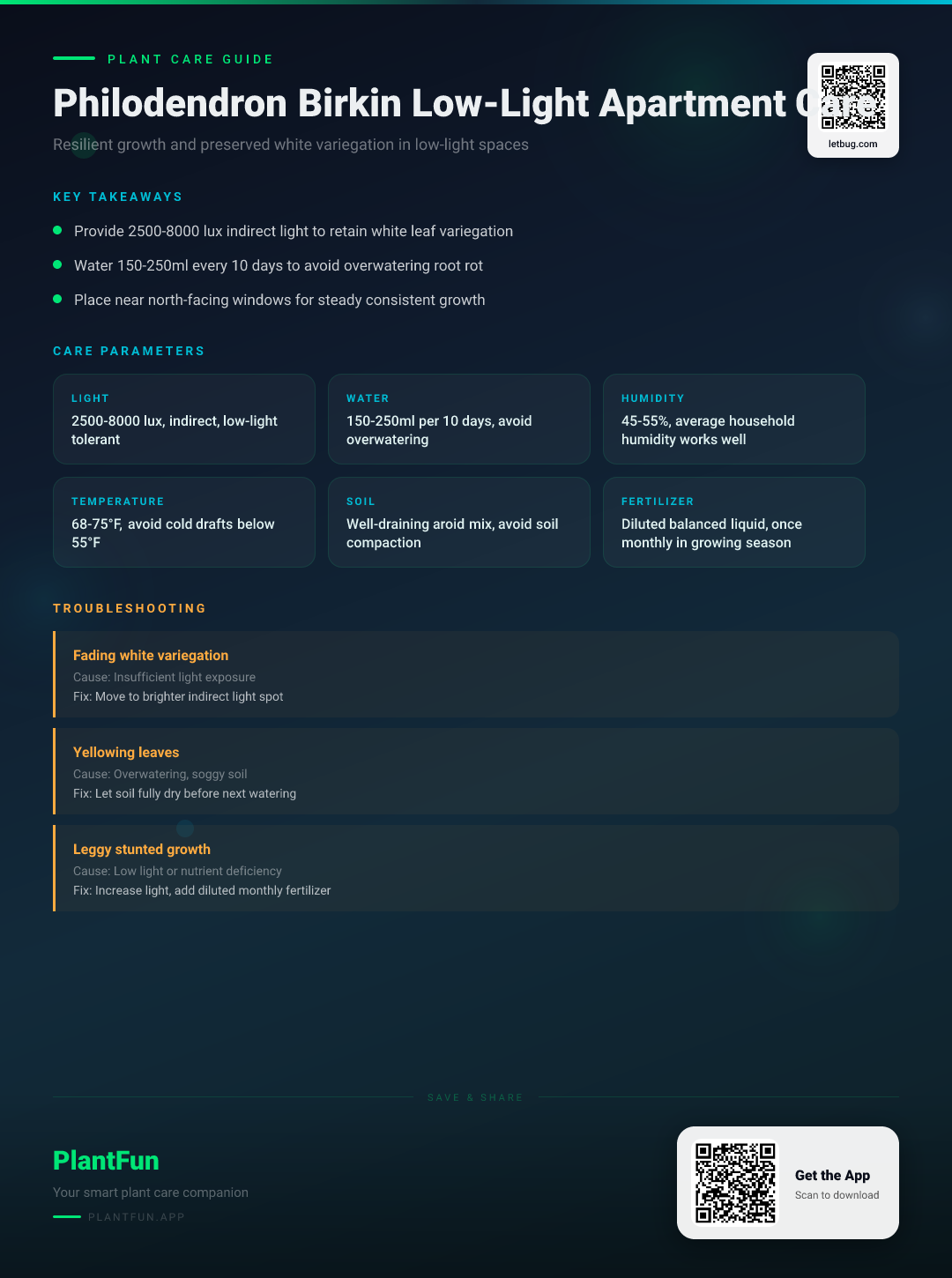
Key Takeaways
- Check soil moisture before watering — overwatering is the #1 killer of houseplants.
- Ensure your plant gets the right amount of light for its species.
- Be patient with recovery — most plants need 2–4 weeks to bounce back.
TL;DR: Quick Care for the Apartment Dweller
The Philodendron ‘Birkin’ is a slow-growing cultivar that requires stable, bright, indirect light (2,500–8,000 lux) to maintain its signature pinstripes. In low-light apartments, growth slows significantly, making overwatering the primary threat. Water with 150–250ml only when the top 2 inches of soil are dry. Keep temperatures between 68–75°F and humidity at 45–55%. Please note: The ASPCA lists this plant as toxic to pets (ASPCA, 2026).
My Experience: Lessons from a Dark Apartment
When I first brought home my ‘Birkin,’ I placed it in a dim corner of my studio, convinced it was a “low-light plant.” Within three weeks, the vibrant white pinstripes began to revert to solid green, and I noticed the soil staying damp far too long. I learned the hard way that ‘Birkin’ doesn’t just want to survive; it needs specific light energy to manufacture those beautiful white, cream-colored stripes (NC State Extension, 2026). My transition to a consistent, light-monitored routine saved the plant from root rot.
Quick Care Card: Essential Data
| Feature | Requirement |
|---|---|
| Light | 2,500–8,000 Lux (Bright, Indirect) |
| Watering | 150–250ml every 10–14 days (drip dry) |
| Humidity | 45–55% |
| Temperature | 68–75°F (20–24°C) |
| Soil | Well-draining, peat-based mix |
| Fertilizer | Balanced liquid feed, monthly (Spring/Summer) |
| Toxicity | Toxic to cats and dogs (ASPCA, 2026) |
Why Your Birkin Struggles in Low-Light Apartments: Understanding Photosynthetic Limitations
In nature, Philodendron species thrive under forest canopies. However, the ‘Birkin’ is a mutation that relies on specific pigments for its variegation. In low-light apartments, the plant struggles to perform enough photosynthesis. As an evolutionary survival mechanism, it will often produce more chlorophyll (the green pigment) and less of the white pattern to maximize light capture. If you find your plant is turning green, it is literally starving for light.
Identifying Light-Stress Symptoms: When the Variegation Fades or Disappears
Watch for these signals:
- Fading pinstripes: New leaves emerge mostly solid green.
- Leggy growth: Large gaps between leaf nodes as the plant “stretches” toward the window.
- Drooping: A sign the plant lacks the energy to maintain turgor pressure in its stems.
Root Cause Analysis: Why Overwatering is the #1 Apartment Killer for Philodendrons
In low-light conditions, metabolic processes slow down. A plant that uses 300ml of water a week in the summer may only need 100ml in a dark winter month. Excess water fills the air pockets in the soil, suffocating roots and leading to decay. Research into in vitro propagation shows that controlled nutrient and water uptake is essential for maintaining the health of this specific cultivar (Akramian et al., 2024).
The 3-Step Watering Protocol
- The Finger Test: Insert your index finger 2 inches into the substrate. If you feel any moisture, do not water.
- The Volume Check: If dry, add 150–250ml of room-temperature water. Never allow the pot to sit in standing water.
- Visual Confirmation: If the leaves are curling, the plant is dehydrated; if the base is yellowing, it is overwatered.
Correcting Light Levels: How to Optimize North-Facing Windows
If your apartment faces North, your light is likely insufficient. Place your ‘Birkin’ on a pedestal or windowsill to ensure it receives at least 2,500 lux. Do not place it behind heavy curtains, which can reduce light intensity by up to 50%.
FAQ
- Why is my Philodendron Birkin losing its white stripes? It is likely not receiving enough light to sustain the variegation. Move it closer to a bright, indirect light source.
- Can I put my Birkin in the bathroom? Yes, if there is a window. The higher humidity (45-55%) is beneficial, but ensure the pot has drainage holes (NC State Extension, 2026).
- How often should I fertilize my Birkin to keep it healthy? Apply a balanced liquid houseplant fertilizer once a month during the growing season (spring to early autumn) at half strength.
Seasonal Calendar: Adjusting Care
- Summer: High light allows for more frequent watering (every 7–10 days).
- Winter: Low light and cooler temperatures mean the plant enters a semi-dormant state. Water sparingly (every 14–18 days) (Akramian et al., 2024).
Common Mistakes to Avoid
- Mistake: Using a decorative pot without drainage.
- What happens: Water accumulates at the bottom, rotting roots.
- Instead: Use a nursery pot inside a decorative cachepot.
- Mistake: Placing in direct hot sun.
- What happens: Scorched leaves (brown, crispy edges).
- Instead: Use a sheer curtain to diffuse intense light.
Step-by-Step Recovery Plan for Leggy or Stressed Plants
- Pruning: If the plant is severely leggy, use sterile shears to remove the top few nodes to encourage bushier growth (Tasnim et al., 2025).
- Lighting: Immediately move the plant to a spot where it receives at least 4,000 lux for 6–8 hours daily.
- Monitoring: Withhold fertilizer for 4 weeks to allow the root system to recover from potential stress.
References
- Akramian, M.; Khaleghi, A.; Salehi Arjmand, H. (2024). Optimization of plant growth regulators for in vitro mass propagation of Philodendron cv. Birkin through shoot tip culture. Greenhouse Plant Production Journal. https://doi.org/10.61186/gppj.1.1.55. Accessed 2026-03-17.
- Tasnim, N.; Rahman, K.; Sarker, S. (2025). In vitro Mass Propagation of Philodendron cv. ‘Birkin’ through Direct and Indirect Organogenesis. Plant Tissue Culture and Biotechnology. https://doi.org/10.3329/ptcb.v35i1.82285. Accessed 2026-03-17.
- ASPCA. (2026). Toxic and Non-Toxic Plants List — ASPCA. https://www.aspca.org/pet-care/animal-poison-control/toxic-and-non-toxic-plants. Accessed 2026-03-17.
- NC State Extension. (2026). Philodendron Birkin — NC State Extension Gardener Plant Toolbox. https://plants.ces.ncsu.edu/plants/birkin-care/. Accessed 2026-03-17.
Optional Helper: Plantfun.App
Plantfun.App identifies your plants by photo, diagnoses pests and diseases with clear fixes, and creates personalised watering and light schedules that adapt to your home conditions — a handy companion for putting this guide into daily practice.
Found an error or have suggestions? We'd love your feedback.
Need help identifying this problem?
Get instant identification, personalized care schedules, and effective pest treatment plans directly on your phone.
Sponsored • We may earn a commission from app downloads
Related Guides
Philodendron Birkin in Low-Light Apartments: A Resilient Growth and Seasonal Care Guide
Transform your Philodendron Birkin into a thriving centerpiece. Follow our expert seasonal checklist, precise watering logs, and light-tuning tips for apartments.
Care GuidePhilodendron Birkin in Small Urban Apartments: The Resilient Growth Care Checklist You’ll Ever Need
Grow a lush, variegated Philodendron Birkin even in a cramped city apartment. Get exact light, water, and humidity thresholds plus a 12-point checklist to avoid common stress and support year-round resilient growth.
Care GuidePhilodendron Birkin Care in Dim Apartments: 5 Strategies for Resilient and Vibrant Growth
Master Philodendron Birkin care in your apartment with 5 science-backed strategies. Learn exact lux levels and watering cycles for vibrant, lasting variegation.
Pest ControlAnts on Plants: What They Mean and What to Do
Ants usually aren't eating your plant. They are farming other pests.