
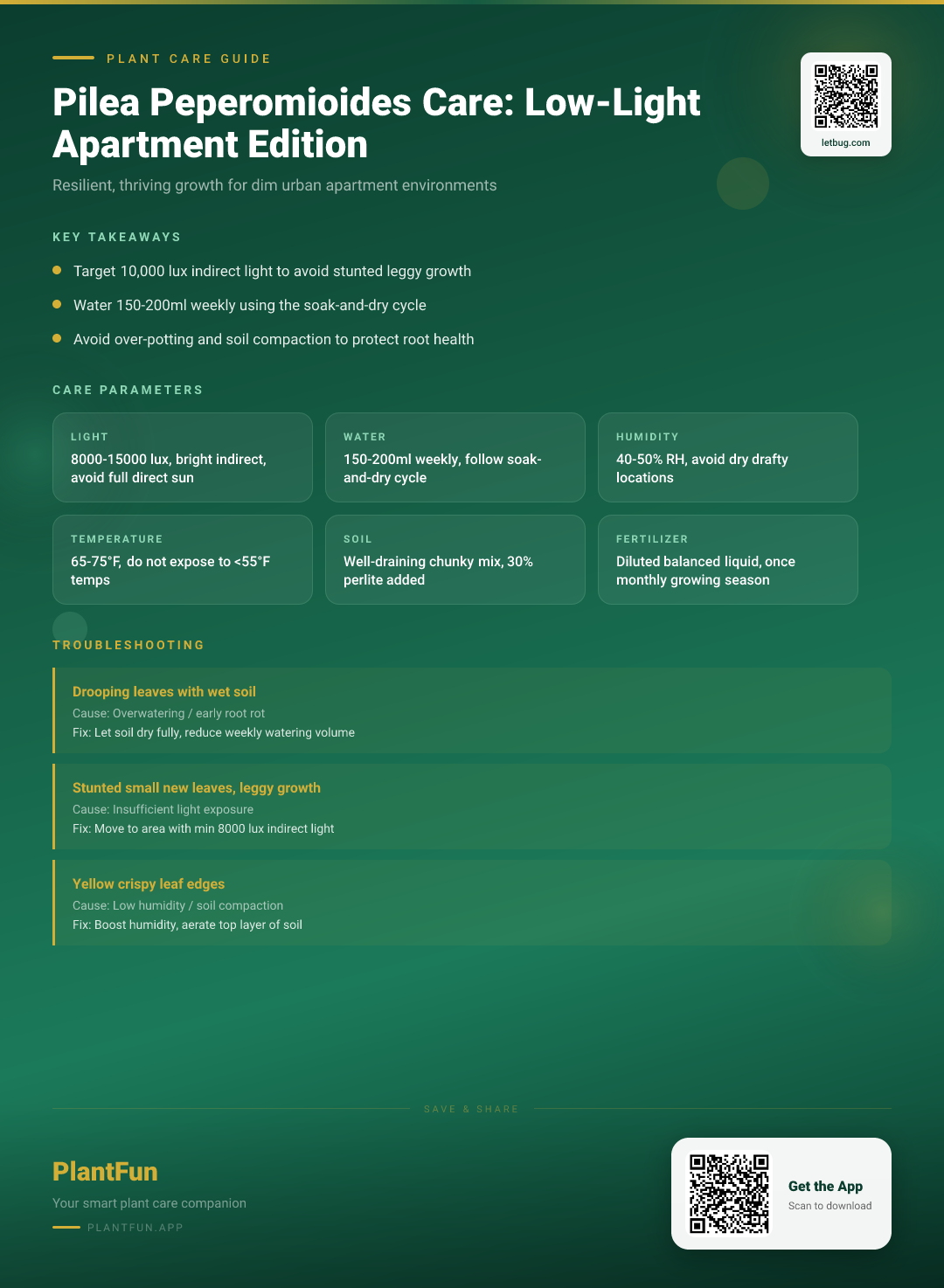
Key Takeaways
- Check soil moisture before watering — overwatering is the #1 killer of houseplants.
- Ensure your plant gets the right amount of light for its species.
- Be patient with recovery — most plants need 2–4 weeks to bounce back.
Quick Care Card: Essential Data
| Feature | Requirement |
|---|---|
| Light | 8,000–15,000 lux |
| Water | 150–200ml per week (seasonal) |
| Humidity | 40–50% |
| Temperature | 65–75°F (18–24°C) |
| Soil | Well-draining, peat-based mix |
| Fertilizer | Balanced liquid (10-10-10) monthly |
| Toxicity | Non-toxic (ASPCA, 2026) |
TL;DR: The Apartment Reality Check
If your Pilea is drooping or looking leggy, it is almost certainly starving for light. In an apartment setting, your plant needs at least 8,000 lux—the equivalent of being within 2 feet of a bright window. Stop watering on a schedule; instead, use the 150-200ml soak-and-dry method, ensuring the soil feels dry two inches down before adding more. Most issues are simply environmental mismatches.
Why Your Pilea Struggles in a Typical Apartment
When I first bought my own Pilea, I placed it on a bookshelf six feet away from a window. Within a month, the beautiful, coin-shaped leaves started curling and the stem began to lean aggressively toward the glass. I realized I was treating it like a low-light pothos when, in reality, Pilea peperomioides thrives in much higher intensity zones. The limited airflow and inconsistent light levels in modern apartments often lead to stunted, “leggy” growth where the plant desperately stretches for photons.
Step 1: Calibrating Your Light (The 10,000 Lux Rule)
Pilea plants are often mislabeled as low-light survivors. While they can tolerate shadows, they won’t thrive in them.
- Measure: Use a light meter app or sensor to aim for 8,000 to 15,000 lux.
- Positioning: Place your Pilea directly in an east-facing window or 1-2 feet back from a south-facing one.
- Rotation: Rotate your pot 90 degrees every week to prevent permanent leaning toward the light source (NC State Extension, 2026).
Step 2: Mastering the Soak-and-Dry Watering Cycle (150-200ml threshold)
Overwatering is the fastest way to kill a Pilea. I use a simple “finger test”: if the top 2 inches of soil feel moist, walk away.
- The Measure: For a standard 6-inch pot, provide 150-200ml of water only when the substrate is dry.
- Drainage: Never leave your pot sitting in a saucer of standing water. If your decorative pot has no hole, use a plastic nursery liner inside to facilitate drainage.
Step 3: Managing Apartment Humidity and Airflow
Stagnant air in a small apartment can lead to edema—a physiological issue where the plant takes in more water than it can transpire. Keep your Pilea away from heating vents or AC drafts. While they enjoy 40-50% humidity, they are fairly adaptable to home environments (Winter et al., 2021). If your leaves look thin, a pebble tray can help boost local humidity levels slightly without needing a bulky humidifier.
Seasonal Care Calendar: From High-Sun Summer to Dim Winter
- Spring/Summer: Your Pilea is in a growth phase. Increase water slightly, ensuring the soil remains moist but not saturated. Fertilize monthly.
- Fall/Winter: Growth slows down. Reduce watering to every 10-14 days. If your apartment becomes significantly darker, move the plant closer to the window to compensate for shorter day lengths (Radcliffe-Smith, 1997).
Myth-Busting: Why ‘Bright Indirect’ Doesn’t Mean ‘No Sun’
Many gardeners confuse “indirect” with “dark.” In botanical terms, “bright indirect” actually means the plant can see the sky but not the sun’s direct rays. If you hold your hand under the light and it casts a faint, soft-edged shadow, you are in the right spot.
Common Mistakes to Avoid
- Mistake: Using dense, garden-variety soil.
- What happens: Compaction prevents oxygen from reaching the roots, leading to rot.
- Instead: Use a mix of 60% potting soil and 40% perlite for maximum drainage.
- Mistake: Over-potting into a huge vessel.
- What happens: Extra soil holds too much water, causing root suffocation.
- Instead: Only move up one pot size (1-2 inches larger) at a time.
FAQ: Why is my Pilea drooping even though the soil is wet?
This is a classic sign of root rot. When roots are damaged by soggy, anaerobic soil, they cannot transport water to the leaves, even if the pot is soaked. You must unpot the plant, trim away mushy, black roots, and repot in fresh, dry, porous soil.
FAQ: Can I keep my Pilea on my desk away from the window?
Only if you supplement with a full-spectrum LED grow light. Without direct proximity to a window, a Pilea will inevitably lose its characteristic saucer-shaped leaves and become sparse.
FAQ: How do I know if my Pilea is getting enough light?
Look at the leaves. If the plant is getting enough light, the leaves will remain flat and wide. If the edges are curling inward like a taco, the plant is likely trying to conserve moisture due to high heat or intense light, or conversely, it is struggling with light starvation.
Expert Troubleshooting: When to Prune for Structural Integrity
Leggy or Leaning Stems
Symptom: The plant has a long, bare stalk with leaves only at the top.
Likely cause: Years of insufficient light.
Fix:
- Cut the top 4 inches of the stem.
- Place the cutting in water to root.
- Once roots are 1 inch long, replant it to encourage a bushier aesthetic.
References and Botanical Resources
- Winter, K.; Garcia, M.; Virgo, A. (2021). Low-level CAM photosynthesis in a succulent-leaved member of the Urticaceae, Pilea peperomioides. Functional Plant Biology. https://doi.org/10.1071/fp20151. Accessed 2026-03-17.
- Radcliffe‐Smith, A. (1997). A supplementary note on the cultivation of Pilea peperomioides. Curtis’s Botanical Magazine. https://doi.org/10.1111/1467-8748.00063. Accessed 2026-03-17.
- ASPCA. (2026). Toxic and Non-Toxic Plants List — ASPCA. https://www.aspca.org/pet-care/animal-poison-control/toxic-and-non-toxic-plants. Accessed 2026-03-17.
- NC State Extension. (2026). Pilea Peperomioides — NC State Extension Gardener Plant Toolbox. https://plants.ces.ncsu.edu/plants/pilea-peperomioides/. Accessed 2026-03-17.
Optional Helper: Plantfun.App
Plantfun.App identifies your plants by photo, diagnoses pests and diseases with clear fixes, and creates personalised watering and light schedules that adapt to your home conditions — a handy companion for putting this guide into daily practice.
Found an error or have suggestions? We'd love your feedback.
Need help identifying this problem?
Get instant identification, personalized care schedules, and effective pest treatment plans directly on your phone.
Sponsored • We may earn a commission from app downloads
Related Guides
Pilea peperomioides in a Dim Apartment: The 5-Step Guide to Resilient Indoor Growth
Stop letting your Pilea suffer in low light. Master precise watering, specific lux thresholds, and rotation habits to grow a vibrant, symmetrical UFO plant.
Care GuidePilea Peperomioides in a Low-Light Apartment: The Complete Care Guide for Resilient Growth
Rescue your struggling Pilea. Learn the exact 15,000-lux thresholds, seasonal watering ml, and rotation habits needed to keep your plant lush in any apartment.
Care GuidePilea Peperomioides in Low-Light Apartments: A Resilient Care Strategy for Steady Growth
Revive your leggy Pilea with this 4-step apartment survival guide. Master light placement, precise watering, and rotation techniques for a fuller, healthier plant.
Pest ControlAnts on Plants: What They Mean and What to Do
Ants usually aren't eating your plant. They are farming other pests.