
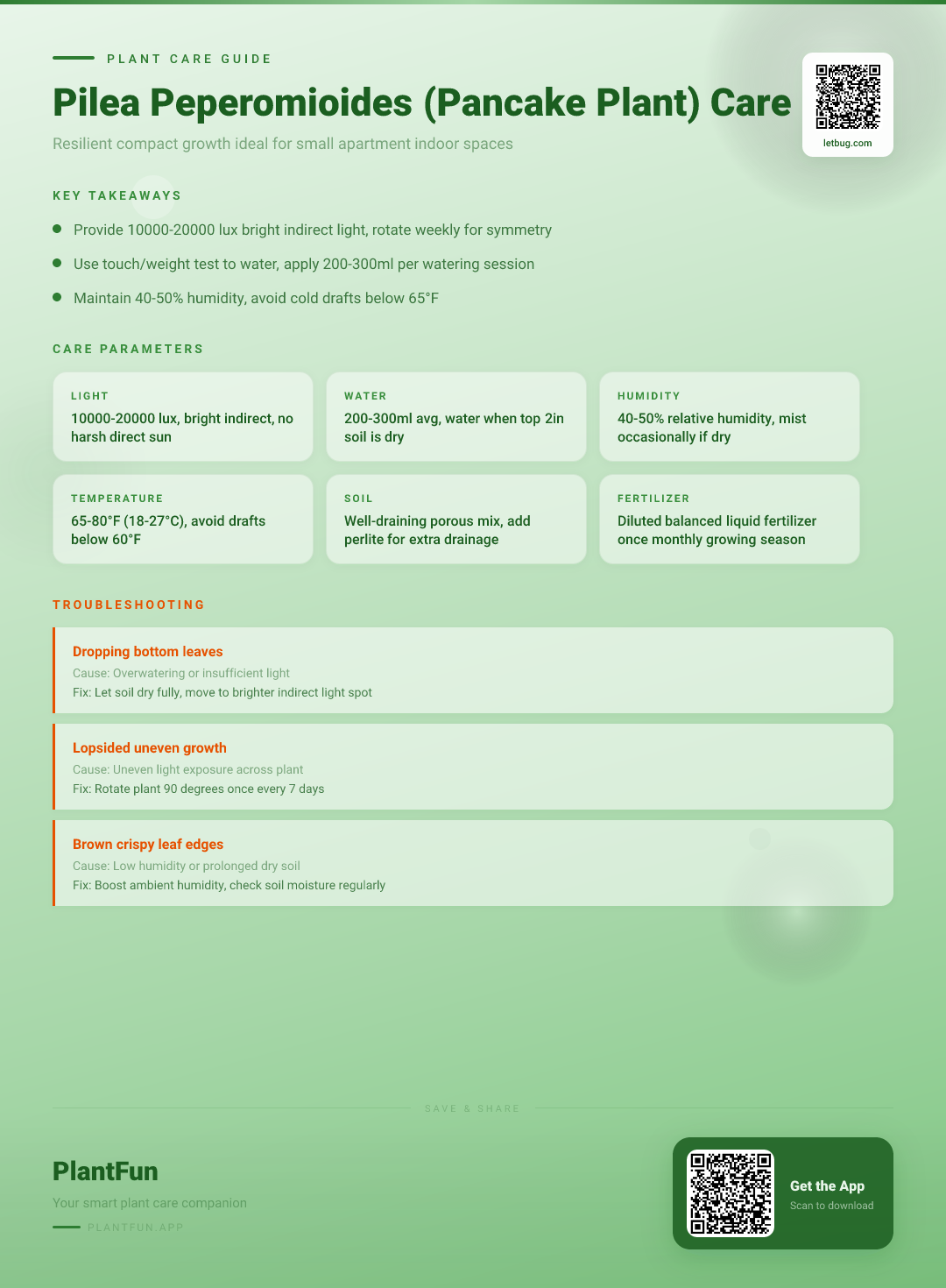
Key Takeaways
- Check soil moisture before watering — overwatering is the #1 killer of houseplants.
- Ensure your plant gets the right amount of light for its species.
- Be patient with recovery — most plants need 2–4 weeks to bounce back.
Pilea Peperomioides in a Small Apartment: The Ultimate Care Guide for Resilient Growth
When I first brought home my very first Pilea, I placed it in a dark corner of my studio apartment, assuming it would be as low-maintenance as a pothos. Within weeks, the iconic coin-shaped leaves began to droop, and the stem grew lopsided. I quickly learned that the “Pancake Plant” requires a more precise touch, especially within the confined, stable environments of modern apartments.
Quick Care Card: Measuring Light, Water, and Temperature
| Feature | Requirement |
|---|---|
| Light | 10,000–20,000 Lux (Bright Indirect) |
| Water | When top 2 inches of soil are dry (200-300ml) |
| Humidity | 40–50% Relative Humidity |
| Temperature | 65–80°F (18–27°C) |
| Soil | Well-draining, peat-based mix with perlite |
| Fertilizer | Balanced liquid 10-10-10 (monthly in growing season) |
| Toxicity | Non-toxic (ASPCA, 2026) |
TL;DR: The Essentials of Apartment-Grown Pilea Peperomioides
To keep your Pilea thriving, prioritize bright, indirect light—aim for 10,000–20,000 lux. Water only when the top two inches of soil feel dry, usually requiring 200-300ml depending on pot size. Because apartments often have stagnant air, rotate your plant weekly to ensure symmetrical growth. Avoid placing it near drafts or heaters, as consistency is key to preventing leaf drop.
Why Your Apartment Environment Is Unique for Pilea Success
Small apartments often suffer from limited light penetration and poor airflow. Unlike a greenhouse, your living space has distinct “microclimates.” Placing your Pilea on a bookshelf away from a window can starve it of the photosynthetic energy it needs, while a south-facing windowsill might scorch the delicate foliage (NC State Extension, 2026). My experience has shown that keeping a Pilea in a compact space requires intentional placement to mimic its natural, high-light habitat.
Light Requirements: Targeting 10,000–20,000 Lux for Compact Growth
Light is the primary driver of Pilea health. A study in Functional Plant Biology highlights the unique photosynthetic habits of this species, noting its succulent-like leaf structure (Winter et al., 2021). If your plant is “leggy” or the stems are reaching, it is starving for light. I recommend using a simple light meter app on your phone to ensure the spot consistently receives 10,000–20,000 lux.
Watering Mastery: Using the ‘Touch and Weight’ Test (200-300ml average)
Overwatering is the fastest way to kill a Pilea. I use the “touch and weight” test: lift your pot; if it feels unexpectedly light, it is time to water. Stick your index finger two inches into the soil. If it feels moist, wait two more days. When watering, apply roughly 200-300ml of water, ensuring that excess drains completely. Never let the pot sit in standing water, as this promotes root rot (Radcliffe‐Smith, 1997).
Temperature & Humidity: Keeping 65–80°F (18–27°C) and 40–50% Relative Humidity
Pilea plants prefer the same indoor temperatures humans do. Aim for a stable 65–80°F range. Apartment air can become quite dry in winter due to heating systems; if you see brown, crispy tips, your humidity likely dipped below 40%. A small pebble tray or grouping plants together can help stabilize moisture levels.
The Seasonal Care Calendar: Adjusting for Winter vs. Summer Growth
- Spring/Summer: This is when your Pilea will push out new growth. Increase watering frequency and start applying a balanced fertilizer once a month.
- Fall/Winter: Growth slows as light levels drop. Reduce water by half and stop fertilizing entirely until spring to allow the plant to enter a mild dormancy.
Why is my Pilea dropping bottom leaves? (Voice Search FAQ)
This is almost always a sign of overwatering or sudden temperature shifts. If the bottom leaves turn yellow and fall off, check your watering schedule immediately. According to the NC State Extension, consistent moisture is preferred over cycles of “drought and flood” (NC State Extension, 2026).
How often should I rotate my Pilea for a symmetrical shape? (Voice Search FAQ)
Because light in an apartment typically comes from one direction, your Pilea will naturally lean toward the window. I rotate my plant 90 degrees every time I water it. This simple habit keeps the stem straight and the foliage balanced.
Can I keep my Pilea in a bedroom without direct sunlight? (Voice Search FAQ)
While it can survive, it will not thrive. If your bedroom lacks natural light, I highly recommend using a dedicated grow light to provide the 10,000+ lux required for healthy leaf production.
Common Apartment Pitfalls: Dust, Airflow, and Improper Potting
- Mistake: Neglecting to clean leaves. What happens: Dust inhibits photosynthesis. Instead: Gently wipe leaves with a damp cloth monthly.
- Mistake: Using a pot without drainage. What happens: Root suffocation. Instead: Always use a pot with bottom holes.
- Mistake: Lack of airflow. What happens: Fungal issues. Instead: Place near a gentle breeze or use a ceiling fan.
Step-by-Step Guide to Propagating Pilea Pups
- Wait for the “pup” to reach at least 2-3 inches in height.
- Gently scrape away the topsoil to locate the connection to the parent plant.
- Use a sanitized, sharp blade to sever the pup.
- Place the cutting in water until roots are 1 inch long, then move to a small 3-inch pot with well-draining soil.
Troubleshooting: When to Repot and When to Fertilize
Pilea turning yellow
Symptom: Leaves lose their vibrant green color and turn pale yellow.
Likely cause: Overwatering or nutrient deficiency.
Fix:
- Check drainage to ensure soil isn’t waterlogged.
- If the soil has been in the pot for over a year, add a balanced liquid fertilizer at half strength.
Pilea leaves curling
Symptom: The edges of the coin-shaped leaves curl inward.
Likely cause: Low light or low humidity.
Fix:
- Move the plant to a brighter location (closer to a window).
- Increase local humidity by clustering it with other plants.
Pilea drooping leaves
Symptom: The entire plant looks sad and the stems lose their turgidity.
Likely cause: Significant underwatering.
Fix:
- Give the plant a thorough soak until water runs from the bottom.
- Allow to drain completely and monitor for recovery over 24 hours.
References
- ASPCA. (2026). Toxic and Non-Toxic Plants List — ASPCA. https://www.aspca.org/pet-care/animal-poison-control/toxic-and-non-toxic-plants. Accessed 2026-03-19.
- NC State Extension. (2026). Pilea Peperomioides — NC State Extension Gardener Plant Toolbox. https://plants.ces.ncsu.edu/plants/pilea-peperomioides/. Accessed 2026-03-19.
- Radcliffe‐Smith, A. (1997). A supplementary note on the cultivation of Pilea peperomioides. Curtis’s Botanical Magazine. https://doi.org/10.1111/1467-8748.00063. Accessed 2026-03-19.
- Winter, K.; Garcia, M.; Virgo, A. (2021). Low-level CAM photosynthesis in a succulent-leaved member of the Urticaceae, Pilea peperomioides. Functional Plant Biology. https://doi.org/10.1071/fp20151. Accessed 2026-03-19.
Optional Helper: Plantfun.App
Plantfun.App identifies your plants by photo, diagnoses pests and diseases with clear fixes, and creates personalised watering and light schedules that adapt to your home conditions — a handy companion for putting this guide into daily practice.
Found an error or have suggestions? We'd love your feedback.
Need help identifying this problem?
Get instant identification, personalized care schedules, and effective pest treatment plans directly on your phone.
Sponsored • We may earn a commission from app downloads
Related Guides
Pilea in Your Apartment: The Only Care Guide You’ll Ever Need for Resilient Growth
Transform your Pilea's growth with our expert care guide. Get exact light levels, precise watering thresholds, and 5 proven steps to stop leaf drop forever.
Care GuideThe Complete Pilea Peperomioides Care Guide for Small Apartments: Resilient Growth All Year
Grow a lush, happy Pilea in your small apartment with exact care thresholds, a seasonal routine, and a printable checklist that prevents overwatering and yellow leaves all year.
Care GuideThe Complete Pilea peperomioides Care Guide for Dim Apartment Living: Light, Water & Growth
Transform your dim apartment into a thriving Pilea habitat. Master precise light tracking, 150ml watering intervals, and growth hacks to keep your Pilea upright.
Pest ControlAnts on Plants: What They Mean and What to Do
Ants usually aren't eating your plant. They are farming other pests.