
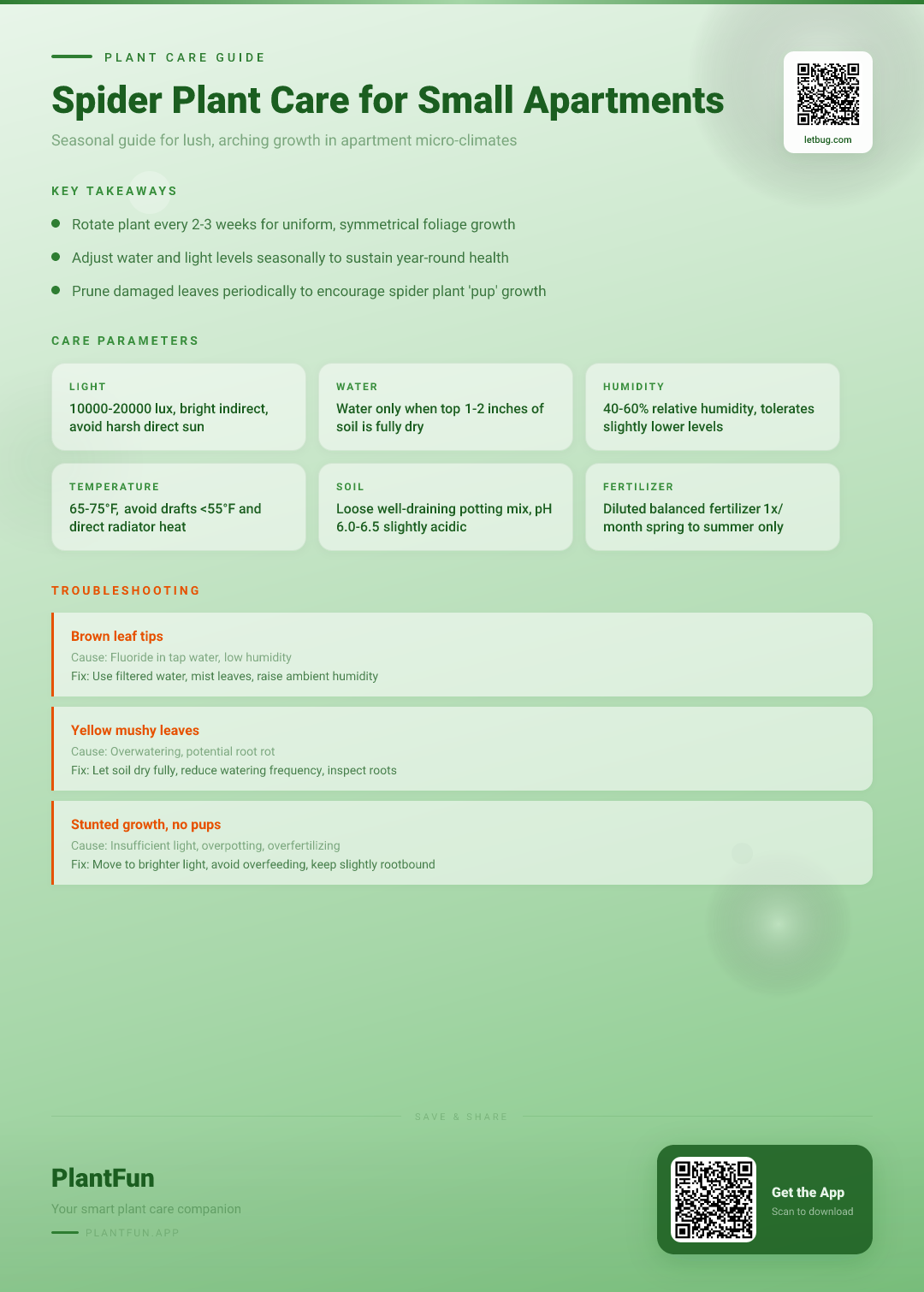
Key Takeaways
- Check soil moisture before watering — overwatering is the #1 killer of houseplants.
- Ensure your plant gets the right amount of light for its species.
- Be patient with recovery — most plants need 2–4 weeks to bounce back.
TL;DR: The Apartment Gardener’s Cheat Sheet
To thrive in an apartment, your Chlorophytum comosum (spider plant) needs bright, indirect light (10,000–20,000 lux), soil that dries out in the top 1–2 inches between waterings, and humidity levels between 40–60%. Keep temperatures steady between 65–75°F. The most common pitfall? Using tap water containing fluoride, which causes brown tips. Always use distilled or filtered water to keep those iconic, arching leaves pristine.
My Experience
When I first brought home my spider plant, I placed it on a windowsill in my drafty, north-facing apartment. I thought “low light” meant “no light.” Within weeks, the variegation faded, and the plant stopped producing those charming plantlets. I realized that while they are resilient, they aren’t magic. I had to move it to a brighter corner and switch to filtered water to fix the crunchy tips I had accidentally caused.
Quick Care Card: Essential metrics for healthy Chlorophytum comosum
| Feature | Requirement |
|---|---|
| Light | 10,000–20,000 lux (Bright, indirect) |
| Water | Allow top 1–2 inches to dry completely |
| Humidity | 40–60% |
| Temperature | 65–75°F (18–24°C) |
| Soil | Well-draining, peat-based mix |
| Fertilizer | Balanced liquid feed monthly (Spring/Summer) |
| Toxicity | Non-toxic to cats/dogs (ASPCA, 2026) |
Why Apartments Challenge Spider Plants: Understanding your indoor micro-climate
In an apartment, your plant exists in a distinct micro-climate. Unlike a greenhouse, apartments often suffer from stagnant air and sudden temperature spikes caused by radiators or air conditioning. As noted in research on indoor ornamental care, maintaining environmental consistency is the key to preventing stress-related decline in indoor species (Halawa & Aisuwarya, 2023).
Measurable Thresholds
- Lighting: Aim for 10,000–20,000 lux. If you don’t have a light meter, imagine the spot where you could comfortably read a book without eye strain.
- Watering: Overwatering is the leading cause of root rot. Always use the “finger test”: push your index finger 2 inches into the soil. If it feels damp, wait two more days.
- Humidity: Apartments often drop below 30% in winter. A small humidifier or a pebble tray can bridge the gap to the 40–60% ideal range.
Spring & Summer: Boosting growth phases with increased light and fertilization
During the active growth season, Chlorophytum comosum thrives on energy. I increase my watering frequency, ensuring the soil stays lightly moist but never waterlogged. This is the time to apply a balanced, water-soluble fertilizer at half-strength once a month.
Autumn & Winter: Navigating radiator-induced dryness and lower light levels
In winter, the plant enters a period of dormancy. Reduce your watering significantly—often by half—to account for the plant’s slowed metabolism. Keep it away from direct heat vents, which can sap moisture from the foliage and lead to crispy, brown tips.
Step-by-Step: Rotating your plant for uniform, symmetrical growth
To ensure your plant doesn’t lean toward the light, follow these steps every 2 weeks:
- Observe the plant’s “lean” toward the primary light source.
- Rotate the pot 90 degrees clockwise.
- Wipe leaves with a damp cloth to remove dust, which improves photosynthetic efficiency (Chaffey, 2001).
FAQ: Frequently Asked Questions
- Why is my spider plant brown at the tips? This is often a reaction to fluoride or chlorine in tap water (NC State Extension, 2026). Try switching to filtered or rainwater.
- Can I keep my spider plant in a room without windows? It won’t thrive without at least 10,000 lux; supplement with a full-spectrum LED grow light for 8–10 hours a day.
- How do I prune my Spider Plant to encourage more babies? You don’t necessarily need to prune for babies, but removing older, dying outer leaves allows the plant to redirect energy toward producing more offsets (pups).
Common Mistakes to Avoid
- Mistake: Watering on a strict calendar schedule. What happens: Root rot and yellowing leaves. Instead: Water based on soil dryness (the top 2 inches rule).
- Mistake: Using untreated tap water. What happens: Chemical buildup causing brown leaf tips. Instead: Use distilled, filtered, or rainwater.
References
- ASPCA. (2026). Toxic and Non-Toxic Plants List — ASPCA. https://www.aspca.org/pet-care/animal-poison-control/toxic-and-non-toxic-plants. Accessed 2026-03-16.
- Chaffey, N. (2001). The true spider plant. Trends in Plant Science. https://doi.org/10.1016/s1360-1385(01)02109-4. Accessed 2026-03-16.
- Halawa, H., & Aisuwarya, R. (2023). Smart Plant Pot Robot with IoT Integration for Indoor Ornamental Plants Care. JITCE (Journal of Information Technology and Computer Engineering). https://doi.org/10.25077/jitce.7.2.97-106.2023. Accessed 2026-03-16.
- NC State Extension. (2026). Spider Plant Care — NC State Extension Gardener Plant Toolbox. https://plants.ces.ncsu.edu/plants/chlorophytum-comosum/. Accessed 2026-03-16.
Optional Helper: Plantfun.App
Plantfun.App identifies your plants by photo, diagnoses pests and diseases with clear fixes, and creates personalised watering and light schedules that adapt to your home conditions — a handy companion for putting this guide into daily practice.
Found an error or have suggestions? We'd love your feedback.
Need help identifying this problem?
Get instant identification, personalized care schedules, and effective pest treatment plans directly on your phone.
Sponsored • We may earn a commission from app downloads
Related Guides
Spider Plant Care for Small Apartments: A 4-Season Guide to Lush, Resilient Growth
Transform your small apartment with a vibrant Chlorophytum comosum. Follow our 4-season routine with precise light, water, and humidity data for year-round growth.
Care GuideSpider Plant Care for Apartment Living: A Seasonal Guide to Resilient Indoor Growth
Transform your apartment into a lush oasis. Master Spider Plant care with seasonal watering schedules, precise light levels, and tips for year-round vitality.
Care GuideThe Complete Spider Plant Care Checklist for Resilient Growth in Small Urban Apartments
Grow lush, trailing spider plants in your small urban apartment without fancy expensive tools. Grab our free 7-item checklist, exact light, water, and soil parameters for zero-fuss, resilient growth year-round.
Pest ControlAnts on Plants: What They Mean and What to Do
Ants usually aren't eating your plant. They are farming other pests.