
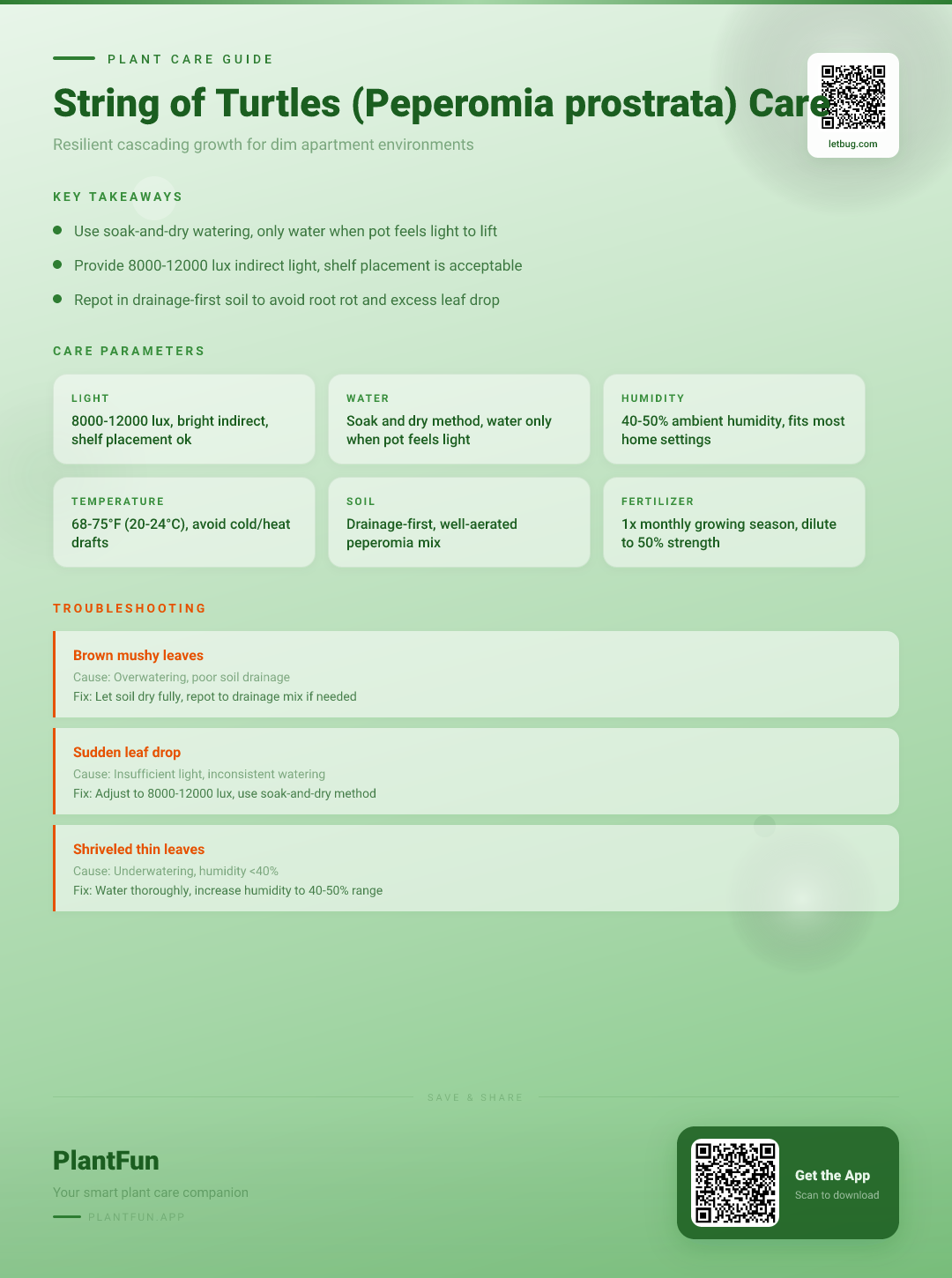
Key Takeaways
- Check soil moisture before watering — overwatering is the #1 killer of houseplants.
- Ensure your plant gets the right amount of light for its species.
- Be patient with recovery — most plants need 2–4 weeks to bounce back.
Quick Care Card: Essential Thresholds for Peperomia prostrata
| Feature | Requirement |
|---|---|
| Light | 8,000–12,000 lux (bright, indirect) |
| Water | Soak when top 50% of soil is dry |
| Humidity | 40–50% ambient humidity |
| Temperature | 68–75°F (20–24°C) |
| Soil | Chunky, well-draining cactus/succulent mix |
| Fertilizer | Diluted balanced liquid (monthly in growth phase) |
| Toxicity | Non-toxic to cats and dogs (ASPCA, 2026) |
TL;DR: The Core Secret to String of Turtles Success
To keep Peperomia prostrata thriving, treat it as a succulent, not a tropical vine. The secret lies in the ‘Soak and Dry’ method combined with high-porosity soil. If you are struggling, prioritize consistent light levels over frequent watering. Most deaths occur due to root suffocation in dense soil rather than underwatering.
Why Your Apartment is a Different Habitat than the Greenhouse
When I first bought my Peperomia prostrata, it arrived in a humidity-controlled greenhouse pod. Moving it to my apartment—with inconsistent drafts and lower light—felt like sending a tropical traveler to the Arctic. Unlike greenhouse-grown specimens, apartment-dwelling turtles need to adjust to lower ambient humidity. According to the NC State Extension (2026), these plants are epiphytic in nature, meaning they grow on other plants rather than in dense ground soil. This is why standard potting soil often leads to rot in our homes.
Light Requirements: Achieving 8,000-12,000 lux in a Dim Living Room
I have found that Peperomia prostrata needs more than just ‘bright light.’ It thrives when it receives roughly 8,000–12,000 lux. In my dim apartment, this means placing the plant directly on a windowsill with a sheer curtain to diffuse harsh midday rays. If your plant is stretching (etiolation), it is searching for light. Move it within 2 feet of a south or east-facing window to ensure healthy foliage density.
Watering Mastery: Why the ‘Soak and Dry’ Method Saves Your Turtles
Never water your turtles on a calendar schedule. I learned this the hard way—my first specimen succumbed to root rot after a two-week watering routine during winter. Instead, use a moisture meter or the ‘finger test.’ Push your index finger two inches into the soil; if it feels cool or damp, hold off. When the top half of the pot is dry, provide a thorough soak until water drains from the bottom (NC State Extension, 2026).
Humidity & Airflow: Keeping Leaves Crisp at 40-50% Ambient Humidity
While many sources claim this plant needs 70%+ humidity, I have found that 40-50% is sufficient if you maintain adequate airflow. Stagnant air is the enemy of succulent leaves. By placing my turtles near a shelf with a small, oscillating fan or ensuring it isn’t tucked in a dead-air corner, I’ve prevented the fungal spotting that often plagues high-humidity terrarium setups (Hoskins, 1998).
Temperature Sensitivity: Maintaining 68-75°F (20-24°C) for Optimal Growth
Peperomia prostrata hates cold drafts. During winter, I move mine away from any windows that leak cold air. Maintaining 68-75°F (20-24°C) keeps the plant in its active metabolism window. Any drop below 60°F can cause the succulent leaves to drop prematurely (NC State Extension, 2026).
Step-by-Step Guide: How to Repot into a Drainage-First Soil Mix
- Prepare the mix: Combine 50% high-quality potting soil with 50% perlite or pumice to ensure rapid drainage.
- Select the pot: Choose a terra-cotta container with drainage holes. The porous clay helps wick excess moisture away from the roots.
- Repotting: Gently tap the plant out of its old container. Tease the root ball slightly, but don’t disturb the crown.
- Placement: Place the plant in the new mix, filling gaps gently. Do not compress the soil too tightly; roots need air to breathe.
- First water: Wait 3–4 days after repotting before your first soak to allow any broken roots to callous.
Seasonal Calendar: Adjusting Care from High-Growth Summer to Dormant Winter
- Spring/Summer: Increase watering as temperatures rise. Apply a half-strength balanced fertilizer monthly to support trailing growth.
- Autumn/Winter: As light levels drop, growth slows. Reduce watering significantly. You may only need to hydrate once every 3–4 weeks (Hoskins, 1998).
Common Mistakes: Stop Watering by Schedule and Start Watering by Weight
- Mistake: Watering every Sunday. What happens: The soil remains waterlogged, leading to rot. Instead: Pick up the pot; if it feels light, it is time to water.
- Mistake: Using dense indoor potting soil. What happens: Lack of oxygen in the root zone causes leaf drop. Instead: Amend with pumice or coarse bark to increase aeration.
FAQ: ‘Why are my String of Turtles leaves turning brown and mushy?’
This is a classic sign of overwatering. The root system has likely failed, and the plant cannot take up nutrients. Remove the plant from the pot, trim away mushy black roots, and repot in dry, airy soil.
FAQ: ‘Can I keep my String of Turtles on a shelf away from the window?’
Technically yes, but growth will be extremely slow and the ‘turtles’ will become sparse. If you do this, I strongly recommend a dedicated grow light to provide the 8,000-12,000 lux requirement mentioned earlier.
References
- ASPCA. (2026). Toxic and Non-Toxic Plants List — ASPCA. https://www.aspca.org/pet-care/animal-poison-control/toxic-and-non-toxic-plants. Accessed 2026-03-18.
- Hoskins, J. (1998). From ‘yocto’ to ‘Yotta’ and How Long Is a Piece of String. Indoor and Built Environment. https://doi.org/10.1177/1420326x9800700401. Accessed 2026-03-18.
- Hoskins, J. (1998). From ‘yocto’ to ‘Yotta’ andHow Long Is a Piece of String. Indoor and Built Environment. https://doi.org/10.1159/000024580. Accessed 2026-03-18.
- NC State Extension. (2026). String of Turtles — NC State Extension Gardener Plant Toolbox. https://plants.ces.ncsu.edu/plants/turtles-care/. Accessed 2026-03-18.
Optional Helper: Plantfun.App
Plantfun.App identifies your plants by photo, diagnoses pests and diseases with clear fixes, and creates personalised watering and light schedules that adapt to your home conditions — a handy companion for putting this guide into daily practice.
Found an error or have suggestions? We'd love your feedback.
Need help identifying this problem?
Get instant identification, personalized care schedules, and effective pest treatment plans directly on your phone.
Sponsored • We may earn a commission from app downloads
Related Guides
String of Turtles in a Dim Apartment: The Ultimate Care Guide for Resilient Growth
Revive your struggling String of Turtles with precise 15,000 lux light targets and a 75% soil-dryness check. Keep your trailing vines lush in any apartment.
Care GuideString of Turtles in a Typical Apartment: The Complete Seasonal Care Guide
Master your String of Turtles care with this expert guide. Get seasonal watering schedules, precise light lux levels, and 3 proven methods for lush growth.
Care GuideThe Complete String of Turtles Care Checklist for Resilient Growth in Small Urban Apartments
Grow lush, trailing String of Turtles even in a small urban apartment. Get our free 8-step budget-friendly checklist with exact light, water, and soil specs to prevent leaf drop and boost resilient growth.
Pest ControlAnts on Plants: What They Mean and What to Do
Ants usually aren't eating your plant. They are farming other pests.